The "Wood Wide Web" Outran Its Evidence. Of 26 Field Studies, Zero Show Mother Trees Feeding Their Young
Ecologists Justine Karst, Melanie Jones, and Jason Hoeksema read every field study of common mycorrhizal networks and found the beloved story of cooperative, communicating forests outran its data: positive results get cited, caveats get dropped, and the share of unsupported claims has doubled in 25 years.
📋 The Study
- Title
- Positive citation bias and overinterpreted results lead to misinformation on common mycorrhizal networks in forests
- Author
- Justine Karst, Melanie D. Jones & Jason D. Hoeksema, 2023 (Univ. of Alberta; Univ. of British Columbia; Univ. of Mississippi)
- Journal
- Nature Ecology & Evolution, 7(4), 501–511 (peer-reviewed Perspective)
- DOI
- doi:10.1038/s41559-023-01986-1
- Sample
- 26 field studies of common mycorrhizal networks in forests (systematic evidence review), plus citation analysis of 593 papers citing 7 influential network-structure studies and 1,083 papers citing 11 network-function studies
- Method
- Systematic evidence review + citation-network analysis (Perspective article, no new field data)
- Key Finding
- Claims that networks are widespread and that transfer improves seedling performance are insufficiently supported; the claim that mature trees preferentially send resources and defense signals to offspring has no peer-reviewed published field evidence; unsupported citations doubled in 25 years
- Effect Size
- ~25% of citations about network structure and ~50% about network function state claims the cited evidence does not support; only 2 of 18 mesh-barrier field studies verified a network actually existed between the experimental plants
- Counterintuition
- ⚡⚡⚡⚡ 4/5
- Replication
- Partially replicated / active scientific debate — independent critiques (Henriksson et al. 2023, New Phytologist; Robinson et al. 2024, Trends in Plant Science) reached similar conclusions; Simard, Ryan & Perry 2025 (Frontiers in Forests and Global Change) disputes the inclusion criteria. No retraction (author correction Mar 2023 removed 4 extraneous references; findings unchanged); no PubPeer controversy.
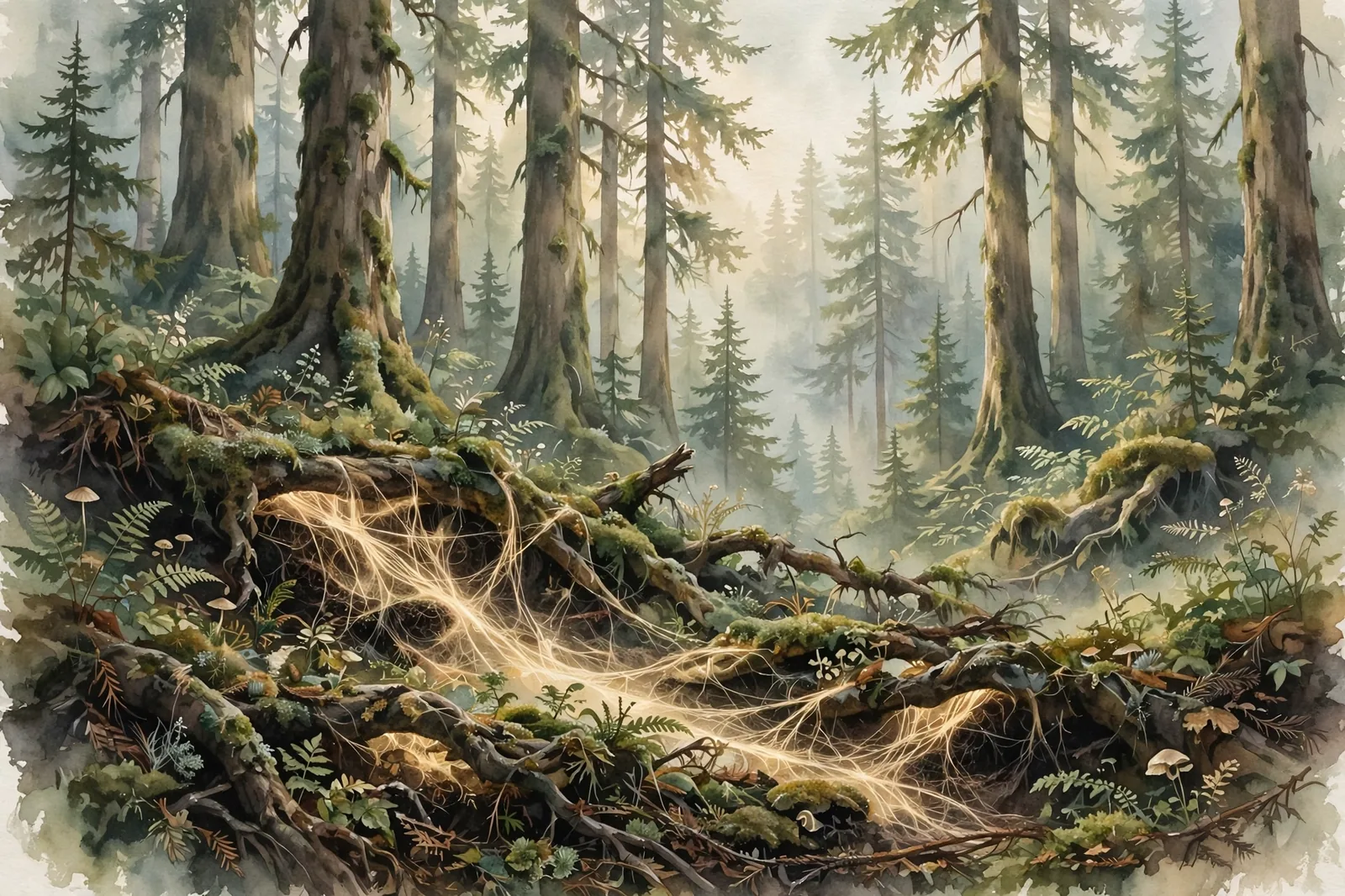
Somewhere between the TED talk and the forest-bathing retreat, the wood wide web became fact. Suzanne Simard's memoir Finding the Mother Tree turned her research into a bestseller. Peter Wohlleben's The Hidden Life of Trees sold millions. A documentary told viewers that ancient trees recognize their offspring, shuttle them food through fungal threads, and broadcast warnings when insects attack. The story showed up in classrooms, in a Radiolab episode, even in a Ted Lasso joke. Forests, we learned, are cooperative utopias wired together by fungus.
In February 2023, three ecologists decided to check the wiring: Justine Karst of the University of Alberta, Melanie Jones of the University of British Columbia, and Jason Hoeksema of the University of Mississippi published a Perspective in Nature Ecology & Evolution testing three beloved claims — that common mycorrhizal networks are widespread in forests, that resource transfer through them improves seedling performance, and that mature "mother trees" preferentially send resources and defense signals to their young.
Start with the map, because there barely is one. A common mycorrhizal network forms when fungal threads connect the roots of multiple plants underground, and confirming such a link in a real forest is brutally hard: digging up the evidence destroys it. Karst's team found that only two studies have ever demonstrated actual continuity of fungal links among trees, one in interior Douglas-fir in British Columbia and one in Japanese red pine. Two stands on a planet of forests. The verdict on claim one: insufficiently supported.
Claim two fared worse under the microscope: of the 26 field studies, 18 used mesh barriers meant to separate fungal from root contact, yet in 16 of those 18 nobody verified that a network actually existed between the experimental plants. Worse, for every study interpreted as network-mediated transfer or seedling benefit, the results could be explained without invoking a network at all: carbon moving through soil water, smaller soil volumes for cut-off seedlings, or shifts in the fungal community. The paper's summary is dry and devastating. Approximately equal evidence links a putative network to improved or inhibited seedling performance, and neutral effects are the most common.
Then the famous one: the mother tree feeding and warning her young is the emotional core of the whole story, and it is the claim with the least behind it, since Karst's team found no peer-reviewed published field evidence for it at all. The insect-warning idea traces to a single greenhouse experiment. A Douglas-fir connected to a ponderosa pine only by fungal threads, never by roots as in real forests, prompted defense chemicals in its neighbor. When the trees were connected by both roots and fungi, the effect vanished. The kin-preference idea traces largely to graduate theses whose results either do not support the claim or run counter to it.
The Bias Is the Finding
The paper's title names the deeper result, which is not about trees but about how science talks to itself: the team evaluated 593 papers citing seven influential studies of network structure and 1,083 papers citing eleven studies of network function. The share of citations stating claims the original evidence did not support has doubled over 25 years, reaching roughly a quarter on network structure and nearly half on function. Positive results got cited while caveats got left behind, and each retelling sanded the uncertainty down a notch. Some unsupported citations, the authors admit, came from their own earlier papers.
Put the map in perspective: the world's forests cover 4.06 billion hectares, per the UN Food and Agriculture Organization, so a few mapped hectares amount to less than one-millionth of one percent. The most confident story in popular forest ecology rests on maps covering less than one-millionth of one percent of the world's forests.
The Strongest Counterargument
Simard's camp has not conceded, and its objections deserve full weight: in a 2025 response in Frontiers in Forests and Global Change, Simard and two coauthors argued that Karst's team searched too narrowly and that their inclusion criteria were subjective and unclear. Simard told CBC the critique answers a claim she never made, that the fungal network is the only pathway operating in a forest, when her papers acknowledge that carbon and signals move through soil, roots, and fungi together.
On the narrow question of whether carbon moves between trees at all, she is right, and Karst does not dispute it: Simard's own 1997 Nature study demonstrated it as the first replicated, controlled field test of resource transfer between tree species, Klein's team showed carbon trade among tall trees in Science in 2016, and laboratory demonstrations go back to 1969. Absence of evidence is not evidence of absence, and the field is young: demanding forest-scale proof before entertaining the hypothesis itself favors the null. Two independent teams reached similar conclusions, Henriksson and colleagues in the New Phytologist and a thirty-author essay in Trends in Plant Science. A formal response literature now exists on both sides, which is what a live scientific debate looks like.
What We Didn't Prove
Here are the honest boundaries: this was a Perspective, a review, not a new experiment, so nobody went out and mapped a third forest. The inclusion criteria are genuinely contestable, which is exactly Simard's objection, and the verdict on the mother-tree claim is provisional: one rigorous field study, with a verified network isolated from soil and root pathways, showing preferential provisioning of kin, would overturn it. The authors do not dispute that carbon can move through fungal threads; they dispute the intentionality layered on top. The 26 studies skew heavily toward western North America, a geographic bias of their own. Finally, coding a citation as "unsupported" required the authors' judgment, the same kind of judgment call they criticize in others.
The Bottom Line
Three separate things got fused into one story, and only two of them are solid. Fungal threads connect tree roots, and carbon and nutrients sometimes move along those connections, as demonstrated decades ago. Ancient trees deliberately provisioning their offspring and sounding alarms through the network: unproven in any forest, by anyone, ever. The myth was never that fungi connect trees. It was the altruism, the intentionality, the certainty ready for management plans.
What You Can Do
When the wood-wide-web story finds you, in a documentary or a classroom or on a trailhead sign, ask which claim is being made — existence, transfer, or altruism — since the first two have real support while the third, the one doing all the emotional work, is the one with nothing behind it. If you work in forestry or restoration, hold off on designing retention or planting plans around mother-tree network benefits. In the authors' own words, the knowledge is "too sparse and unsettled to inform forest management." Push for the decisive experiment instead: verify the network exists, isolate it from soil and root pathways, and test whether kin get preferential treatment; almost none of the 26 studies managed all three. Remember the citation lesson the next time a finding gets more confident traveling from journal to press release to documentary. That drift is the bias Karst measured, and now you know its name.