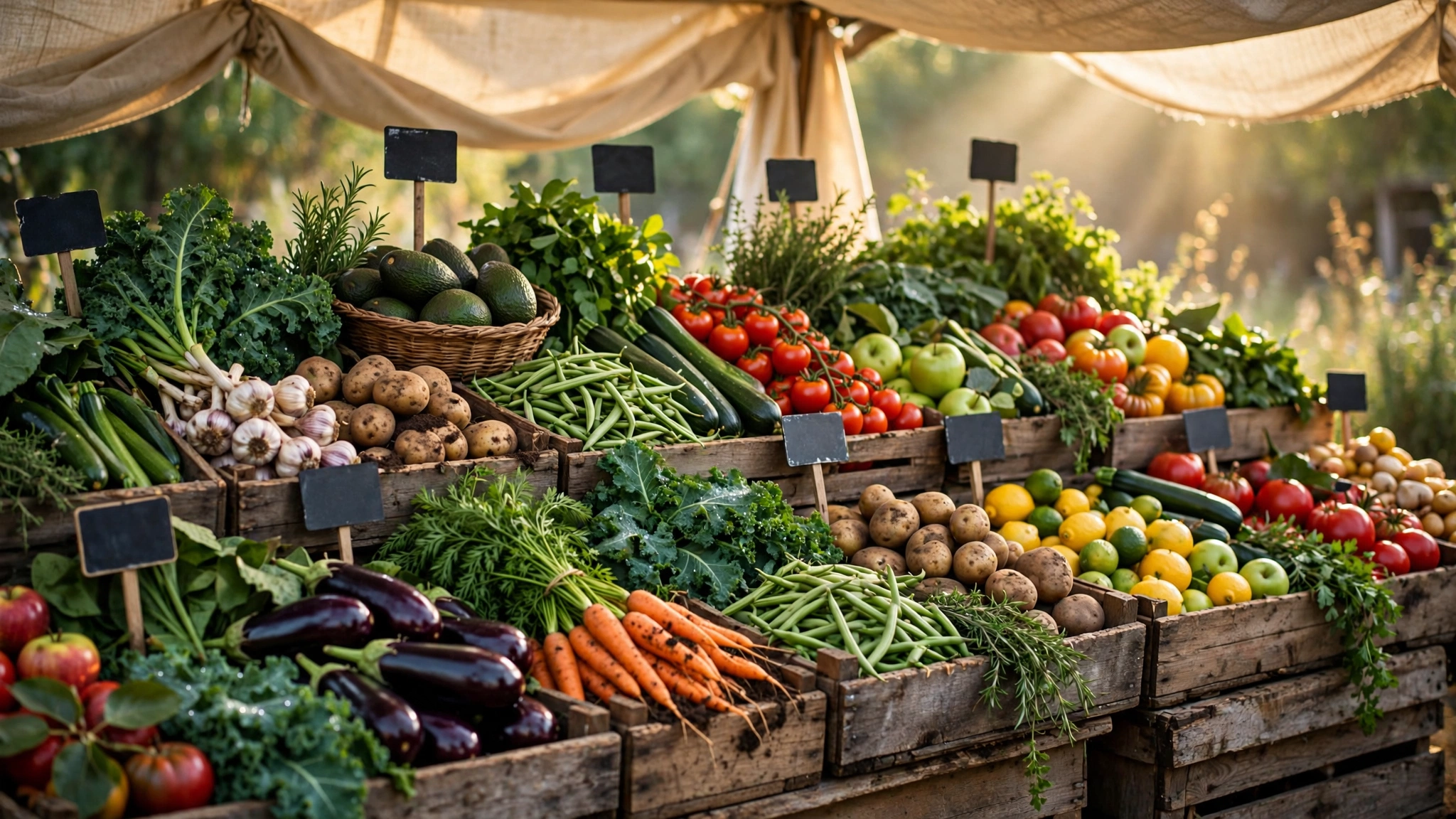
The $70 Billion Assumption
Walk into any grocery store and the math is obvious: organic apples cost $4.99 a pound while conventional apples sit next to them at $2.49. The price gap tells a story most shoppers accept without question: organic is better for you, cleaner, more nutritious, worth every extra dollar.
American consumers believe that story deeply enough to spend $70.1 billion on organic food in 2025 alone, according to the Organic Trade Association, a figure that grew 7% from the year before and three times faster than the overall food market. Seventy-six percent of American households now buy at least one organic product. The USDA organic seal has become shorthand for nutritional superiority.
A Stanford systematic review of 240 studies says the seal doesn't deliver what most people think it does.
What Stanford Actually Found
In 2012, Crystal Smith-Spangler and a team at Stanford's School of Medicine searched six databases spanning 45 years of research. Two independent investigators extracted data from every qualifying study, producing the most comprehensive systematic review ever assembled: 17 human studies and 223 studies comparing nutrient content, pesticide residues, and bacterial contamination across organic and conventional foods.
The conclusion was blunt: no consistent vitamin differences, no meaningful mineral differences, and only one nutrient, phosphorus, significantly higher in organic crops, a finding the researchers dismissed as clinically irrelevant because phosphorus deficiency barely exists in developed countries. Organic produce did show somewhat higher phenolic compounds and omega-3 fatty acids, but these differences were small, inconsistently observed, and of uncertain clinical importance.
"The published literature lacks strong evidence that organic foods are significantly more nutritious than conventional foods." Twelve authors. 240 studies. Forty-five years of data.
What Organic Actually Buys
Where the organic label delivered a real, measurable difference was in what food didn't contain: organic produce was 30% less likely to carry detectable pesticide residues, and conventional chicken and pork showed a 33% higher risk of harboring bacteria resistant to three or more antibiotics.
Those are genuine safety advantages. Real ones. But they are not nutritional advantages, and even the conventional pesticide levels fell within government-set maximum allowable limits.
"Some believe that organic food is always healthier and more nutritious," Smith-Spangler told Stanford Medicine News. "We were a little surprised that we didn't find that."
The Premium-to-Benefit Ratio
Here's a calculation that rarely happens at the checkout counter, one that puts the premium in perspective: Americans pay 20% to 100% more for organic over conventional, which means somewhere between $14 billion and $35 billion flows annually above the conventional price point toward lower pesticide exposure, environmental values, animal welfare, or the belief that the USDA seal means "healthier." Those are legitimate reasons to pay more. But if the primary motivation is nutrition, the evidence says the premium buys almost nothing.
The Strongest Case Against
Two years after Smith-Spangler's review, Marcin Baranski and colleagues at Newcastle University published a larger meta-analysis in the British Journal of Nutrition, analyzing 343 publications. They found organic crops contained 19% to 69% higher concentrations of antioxidants and polyphenolics, along with lower cadmium levels. The team argued these differences were equivalent to eating one to two additional servings of fruit and vegetables daily.
The Baranski analysis cannot be trivially dismissed, but it has a critical gap: higher antioxidant levels in a crop don't automatically translate to health benefits in a human body, a disconnect demonstrated by decades of randomized trials on antioxidant supplements that have consistently shown consuming isolated antioxidants doesn't reduce disease risk and can sometimes increase it. No large, long-term clinical trial has demonstrated that switching from conventional to organic diets produces fewer diseases or longer lives, with all other variables controlled.
A 2020 systematic review by Vigar et al. expanded the evidence to 35 studies and found some observational links between organic diets and lower BMI, but those associations weakened or disappeared once researchers accounted for the inconvenient reality that organic consumers also tend to exercise more, smoke less, eat more produce overall, and earn significantly higher incomes, every one of which independently predicts better health outcomes regardless of whether the food carries an organic seal.
What We Didn't Prove
The human studies Smith-Spangler reviewed were short. Most ran under six months. None was designed to detect long-term health differences, and cumulative low-dose pesticide exposure over years or decades remains a genuinely open question, especially for children, whose developing nervous systems may be more vulnerable than the allowable-limits framework assumes.
The review measured nutrient content, not nutrient absorption. Differences in soil quality, plant maturity at harvest, or food matrix structure could affect bioavailability in ways compositional analysis can't capture. Smith-Spangler's team also acknowledged substantial heterogeneity across the 223 food studies. Organic farming practices vary enormously by region, crop, and certification standard, making sweeping generalizations fragile in both directions.
The Bottom Line
The organic label reliably predicts two things: lower pesticide residues and lower antibiotic-resistant bacteria in meat. It does not reliably predict higher nutritional value. After 240 studies and 45 years of data, the gap between what consumers believe they're buying and what the evidence actually supports remains wide. The organic market isn't built on fraud, but it is built, in large part, on an assumption the science hasn't confirmed.
What You Can Do
If nutrition is your priority, spend the organic premium on more total fruits and vegetables instead. The math is simple. Five servings of conventional produce deliver far more nutritional benefit than three servings of organic, and the quantity of produce you eat matters more than the label on it.
If pesticides concern you, focus organic spending on the Environmental Working Group's "Dirty Dozen," thin-skinned produce like strawberries, spinach, and grapes where residues concentrate. Skip the premium on thick-skinned items like avocados, pineapples, and bananas, where residues are minimal regardless of farming method.
If you buy organic meat and poultry, that's where the evidence is strongest. The 33% difference in antibiotic-resistant bacteria between conventional and organic chicken and pork is a genuine public health concern worth the premium.
Regardless of what you buy, wash your produce. A 2017 study in the Journal of Agricultural and Food Chemistry found that a brief soak in a baking soda solution (one teaspoon per two cups of water) removes significantly more pesticide residues than rinsing alone, from both organic and conventional fruits and vegetables.