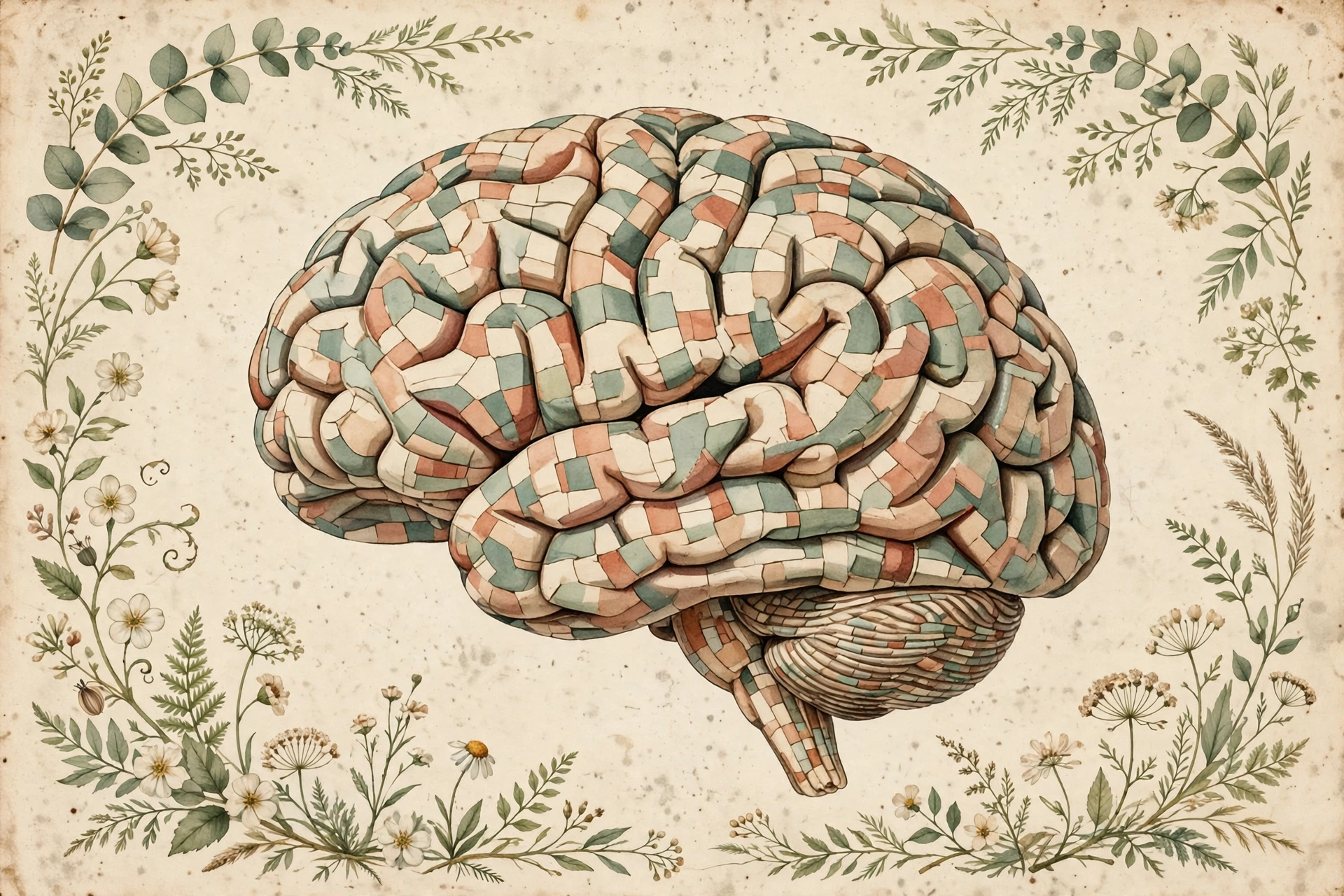
The Two Kinds of Brain
Pick up almost any book about men and women and you will find the same picture: male and female brains are different kinds of hardware, wired differently, built for different jobs. John Gray sold more than 15 million copies of Men Are from Mars, Women Are from Venus on the premise, and Simon Baron-Cohen gave the idea its scientific form in 2002: the male brain systemizes, the female brain empathizes, and autism is an extreme version of the male pattern.
It feels like common sense. Study after study reports a region larger in men or a connection stronger in women, and headlines turn each into a verdict about the sexes. What almost nobody asked is whether those differences add up, because a difference in averages is not the same as a difference in kinds.
A Test With Two Conditions
Daphna Joel and colleagues at Tel Aviv University set out the logic in a 2015 paper. For "male brain" and "female brain" to be real categories, two conditions must hold: first, the features that differ between the sexes must barely overlap, the way male and female genitalia barely overlap. Second, the features inside a single brain must agree with each other: a brain with a male-typical region here should have male-typical regions everywhere else, and if either condition fails, the categories fail with it.
They tested both conditions on more than 1,400 brains from four datasets. In each dataset they picked the regions showing the largest sex differences, the features most favorable to the two-types view, and sorted every region into female-end, male-end, and intermediate zones. Then they counted: how many brains sat entirely at one end, and how many mixed the two? They ran the same analysis on personality and behavior from more than 5,500 people, to check whether behavior sorted into two types.
The 6 Percent
The answer was nearly unanimous. In the Tel Aviv sample of 281 brains, only 6 percent were internally consistent, with all ten measured regions at the same end or all in the middle, and just 2.4 percent had all ten regions at the male end or all ten at the female end, while about a third, 35 percent, carried both male-end and female-end regions at once. The rest were mosaics. Across all four datasets, internally consistent brains ran from 0 to 8.2 percent and substantially variable brains from 23 to 53 percent, and behavior told the same story: in the Add Health sample, nobody was internally consistent, and 70 percent were substantially variable.
The overlap is the part that should change how you read the headlines. Even the features selected for the largest sex differences, with Cohen's d between 0.7 and 1.0, overlapped heavily. Two normal distributions separated by a d of 0.8 overlap by about 69 percent, and at a d of 1.0 the overlap is still about 62 percent, against roughly 37 percent for height, where men average about 13 centimeters taller than women, so the most "male" and "female" features of the brain overlap nearly twice as much as height does, and averages differ while kinds do not follow.
If only about 6 in 100 brains are internally consistent, then roughly 94 in 100 are mosaics: across 8.2 billion people, roughly 7.7 billion mosaic brains against 500 million internally consistent ones. The "male brain" and the "female brain" are not the two common types. They are the rare exceptions.
The Strongest Counterargument
The paper drew four published replies within four months, and the strongest objection is serious: a computer can tell a male brain from a female brain. Adam Chekroud and colleagues trained a classifier on the mosaic itself, the whole pattern of a brain's features, using 1,566 scans, and it predicted sex with 93 percent accuracy, 92 percent even after head-size measurements were removed. Jonathan Rosenblatt reached about 80 percent on Joel's own data, and Marco Del Giudice and colleagues reached 69 to 77 percent. If the two types do not exist, the critics asked, how can a machine sort brains by sex nine times out of ten?
Joel's reply draws a line the critics cross without noticing: a classifier and a category are different things. A machine can sort faces by sex from hundreds of small cues too, and nobody concludes that faces come in two kinds, because the classifier adds up many small differences, each overlapping, until the total tips one way, which is exactly what a mosaic predicts. When head size was regressed out, accuracy fell from 93 percent to 70 percent: a large share of the signal was plain size, not a male or female pattern, and Del Giudice's team also supplied the cleanest validation: applied to primate faces, which really do come in distinct species types, the method found substantial variability in zero profiles. The method detects real categories when they exist. In human brains, it did not.
Marek Glezerman argued that structure is not function: a brain can be a mosaic anatomically while still working in a sex-typical way, and Joel's data cannot answer that, because the study measured structure, not activity. It is a genuine limit, and it is why the paper's claim is about categories of brains, not about whether sex influences the brain at all. It plainly does.
What We Didn’t Prove
This study cannot tell you why any brain feature differs between the sexes, because it measured structure in adults, not hormones, genes, or experience. The samples came mostly from Western datasets, and the analysis used recorded sex, so it cannot separate biology from the effects of living as a man or a woman. The zone boundaries were set at the outer third of each distribution, a choice robust to other cutoffs, but a different definition of "male-end" would move the percentages. Men and women differ in disease risk, drug metabolism, and treatment response, and none of that disappears because brains are mosaics, but the justification for sorting people into two brain types does.
The Bottom Line
The brains of men and women differ on average, in many small ways, and those differences are real, but in more than 1,400 MRI scans, the differences almost never added up to two kinds of brain. Only about 6 in 100 brains were internally consistent. The rest were mosaics, mixtures of features more common in one sex, more common in the other, and common in both. The "male brain" and the "female brain" are shorthand for a pattern of averages, and a poor description of any actual brain.
What You Can Do
When a headline claims a study found the male brain or the female brain, ask one question: did it find a difference in averages, or a difference in kinds, since a difference in averages is common and usually small, while a difference in kinds is what the mosaic study tested, and it is what almost never shows up. Be skeptical of toys and classes sold as matched to a boy brain or a girl brain: there is no such type to match. And keep the distinction where it counts most: in medicine, sex differences in risk and drug response are real, but they are differences in probability, not in brain type. Treat people as mosaics: that is what the scans show they are.
Sources
- Joel, D., Berman, Z., Tavor, I., Wexler, N., Gaber, O., Stein, Y., Shefi, N., Pool, J., Urchs, S., Margulies, D. S., Liem, F., Hänggi, J., Jäncke, L., & Assaf, Y. (2015). Sex beyond the genitalia: The human brain mosaic. Proceedings of the National Academy of Sciences, 112(50), 15468-15473. doi:10.1073/pnas.1509654112
- Chekroud, A. M., Ward, E. J., Rosenberg, M. D., & Holmes, A. J. (2016). Patterns in the human brain mosaic discriminate males from females. Proceedings of the National Academy of Sciences, 113(14), E1968. doi:10.1073/pnas.1523888113
- Del Giudice, M., Lippa, R. A., Puts, D. A., Bailey, D. H., Bailey, J. M., & Schmitt, D. P. (2016). Joel et al.'s method systematically fails to detect large, consistent sex differences. Proceedings of the National Academy of Sciences, 113(14), E1965. doi:10.1073/pnas.1525534113
- Rosenblatt, J. D. (2016). Multivariate revisit to "sex beyond the genitalia". Proceedings of the National Academy of Sciences, 113(14), E1966-E1967. doi:10.1073/pnas.1523961113
- Joel, D., Persico, A., Hänggi, J., Pool, J., & Berman, Z. (2016). Reply to Del Giudice et al., Chekroud et al., and Rosenblatt: Do brains of females and males belong to two distinct populations? Proceedings of the National Academy of Sciences, 113(14), E1969-E1970. doi:10.1073/pnas.1600792113
- Glezerman, M. (2016). Yes, there is a female and a male brain: Morphology versus functionality. Proceedings of the National Academy of Sciences, 113(14), E1971. doi:10.1073/pnas.1524418113
- Joel, D., & Fausto-Sterling, A. (2016). Beyond sex differences: New approaches for thinking about variation in brain structure and function. Philosophical Transactions of the Royal Society B: Biological Sciences, 371(1688), 20150451. doi:10.1098/rstb.2015.0451
- Baron-Cohen, S. (2002). The extreme male brain theory of autism. Trends in Cognitive Sciences, 6(6), 248-254. doi:10.1016/S1364-6613(02)01904-6