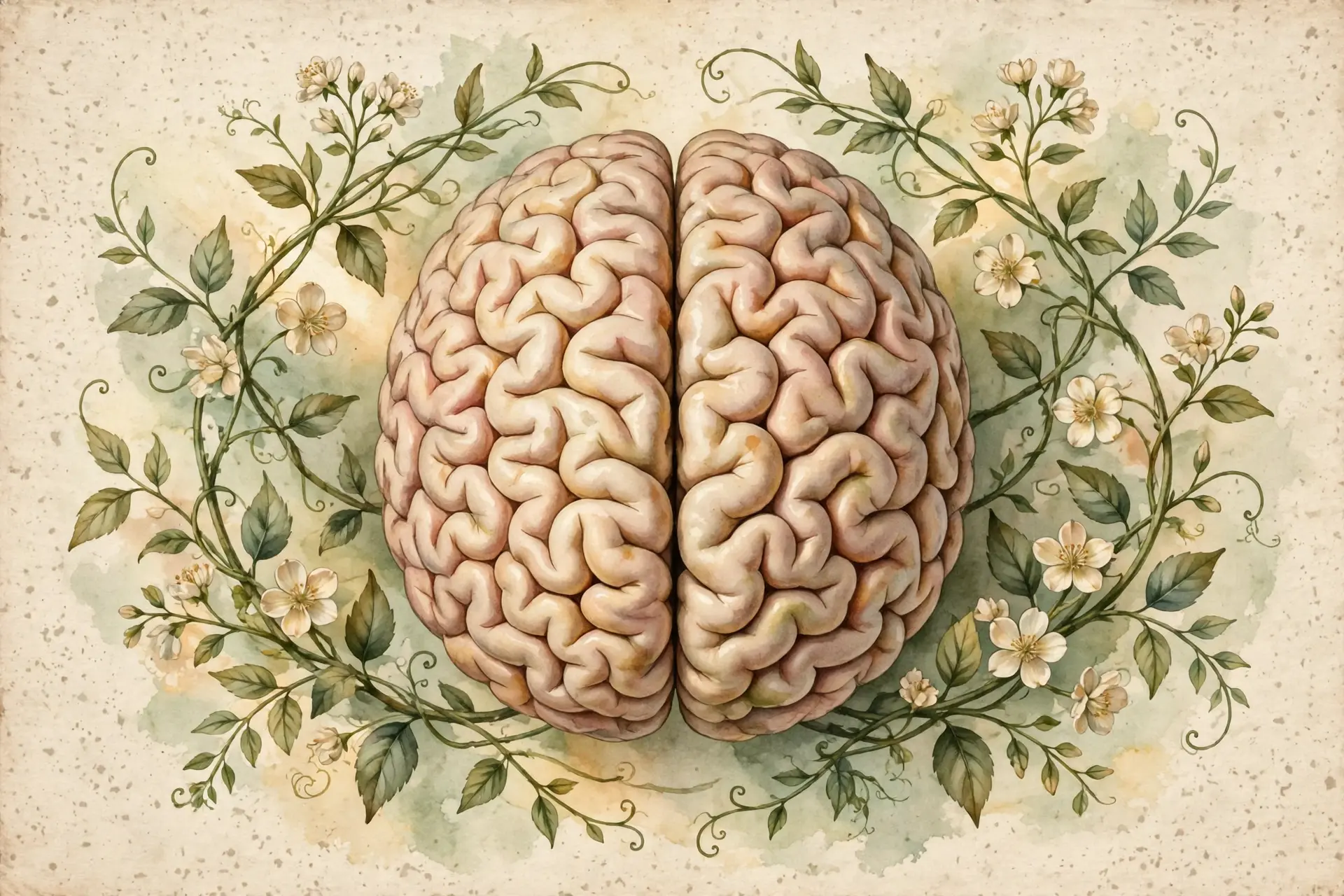
The Quiz Everyone Has Taken
You have taken the quiz, or watched someone take it. Ten questions, and at the end a verdict: left-brained, logical and methodical, or right-brained, creative and intuitive. In 2012, Sanne Dekker and colleagues asked 242 school teachers in Britain and the Netherlands about 32 statements on the brain, and 91 percent of the British teachers and 86 percent of the Dutch teachers marked one statement correct: differences in hemispheric dominance can help explain individual differences amongst learners. Later surveys across five countries put the average at 80 percent. The belief is not a fringe idea; it is the majority view among the people who teach children.
The labels also sell: brain-training programs promise to strengthen your weaker hemisphere. All of it rests on one claim: that each person has a stronger left-sided or right-sided brain network, and that the stronger side shapes how they think. In 2013, a team at the University of Utah decided to test that claim directly, in more than a thousand brains.
Where the Idea Came From
The idea has a genuine scientific ancestor: in the early 1960s, surgeons treating severe epilepsy cut the corpus callosum, the fiber bundle joining the two hemispheres, and Roger Sperry's laboratory at Caltech, working with Michael Gazzaniga, tested what each isolated hemisphere could do on its own. Their 1962 paper reported a patient who could name an object placed in the right hand but not one placed in the left hand. Language lived mostly on the left, and spatial and visual processing leaned right. Sperry won the Nobel Prize in Physiology or Medicine in 1981 for the split-brain work.
None of that work said anything about personality: the patients had their hemispheres surgically disconnected, and the researchers measured specific tasks, not cognitive styles. The leap from "language is processed more on the left" to "logical people are left-brained" happened later, in popular books and training manuals. A real finding became a slogan, and the slogan outlived the science.
1,011 Brains, 7,266 Regions Each
Jared Nielsen, Jeffrey Anderson, and colleagues at the University of Utah set out to check the slogan, gathering resting-state brain scans from 1,011 people aged 7 to 29, from 36 scanning sites in two open data projects. Each volunteer lay in a scanner for 5 to 10 minutes. The team divided each brain into 7,266 regions and measured how strongly each region correlated with every other in the same hemisphere, then flipped each scan across the midline and measured again, so that for every connection they could ask one question: stronger on the left, or on the right?
The lateralization showed up exactly where textbooks say it should. Nine hubs leaned left, including the classic language regions, Broca's area and Wernicke's area. Eleven hubs leaned right, including regions that steer attention toward the outside world. The halves of the brain do specialize, and the question was whether that specialization adds up to a left-brained or right-brained kind of person.
The Test That Came Back Empty
Here is the test: if some people run a stronger left-sided network and others run a stronger right-sided network, then the strength of left-leaning connections should rise and fall together across people, and the team tested exactly that by running 1,620 comparisons between left-hub connections and right-hub connections. Only 36 came back significant, about 2.2 percent. Two-thirds of the 36 involved hubs less than 10 millimeters from their mirror image, so the same tissue was probably measured twice. Strip those out and 12 of 1,620 remain, 0.7 percent, a rate consistent with noise. A whole-brain type would have shown up across hundreds of connections, but it showed up in almost none.
Inside each network the story was the same, nearly every pair of correlated connections sharing a single hub, and there were no differences between men and women, with lateralization creeping up only slightly with age.
Anderson put it plainly: "It is absolutely true that some brain functions occur in one or the other side of the brain. Language tends to be on the left, attention more on the right. But people don't tend to have a stronger left- or right-sided brain network." The paper's summary is blunter: the data are not consistent with a whole-brain phenotype of greater left-brained or right-brained network strength.
The Strongest Counterargument
The strongest case against this result starts with what the scanner was measuring. The volunteers lay still, thinking of nothing, for 5 to 10 minutes. Resting-state connectivity captures the brain's idle wiring, not what happens during a math problem or a painting. A global tendency could appear only under load, where a resting scan would miss it. The study never measured personality, creativity, or cognitive style, so it tests the proposed mechanism, a stronger left or right network, rather than the folk claim itself, and if left-brained people exist for another reason, this study would not see them.
It measured connection strength between mirror-image regions, not what those connections compute, so a left-hemisphere connection and its right-hemisphere twin could carry entirely different information at identical strength, and the method would record no asymmetry at all. The age cap of 29 leaves open the possibility that lateralization consolidates later in life, though the tiny age correlations point the other way, and Knecht and colleagues found in 2000 that only 7.5 percent of 188 healthy right-handers showed right-hemisphere language dominance, so language lateralization is a real individual trait, and atypical lateralization is linked to autism and schizophrenia. Specific functions lateralize; people do not.
What We Didn’t Prove
This study does not prove the two hemispheres are identical, or that no individual differences in lateralization exist; it proves something narrower, that in 1,011 resting brains the strength of left-leaning and right-leaning networks did not covary into a whole-brain type. No task was performed in the scanner, and the analysis speaks to connection strength, not to the content of neural computation, so a future study that scans people while they work and follows them across decades could still find something this one missed, but it would have to find a pattern that 1,620 comparisons across 1,011 brains failed to show.
The Bottom Line
Your hemispheres specialize, and you do not. Language leans left and attention leans right, and those local tilts are real, but they do not add up to a left-brained or right-brained person, and no scan of 1,011 people found anyone whose whole network tilted one way. The quiz was sorting people by a trait that does not exist.
What You Can Do
Stop sorting people by hemisphere. If someone describes a child or colleague as right-brained, treat it as a metaphor for a preference, not a fact about their brain, and stop paying for programs that promise to balance one hemisphere, since the training targets a division the scans do not support. Spend it on strategies with evidence behind them, like retrieval practice and spaced repetition. When a brain-based product makes a claim, ask which function was measured, in how many people, and against what control. If the answer is a personality quiz, you have your answer.