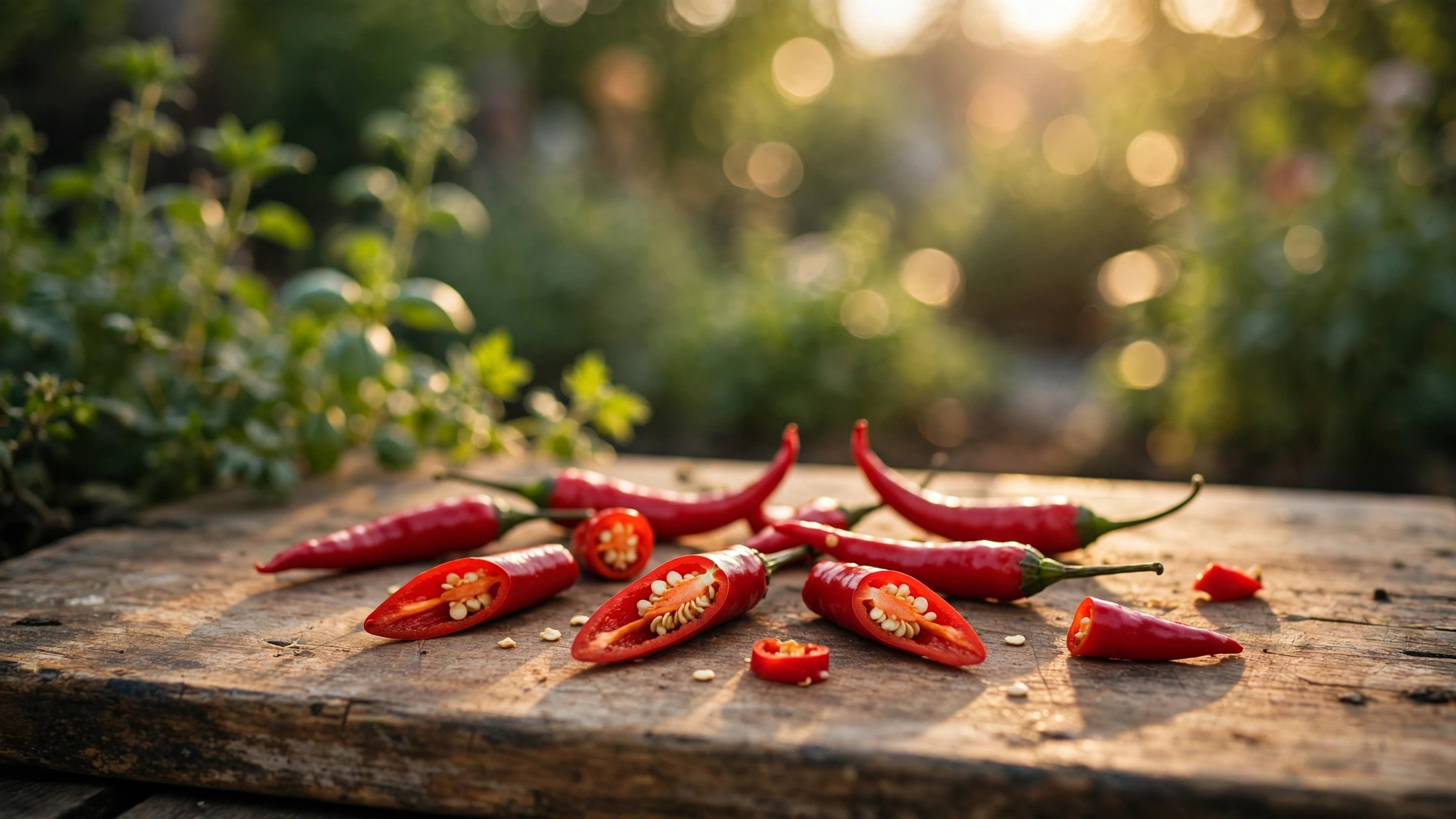
The Warning That Never Needed Evidence
Spicy food hurts your stomach, causes ulcers, and triggers acid reflux, or so the conventional wisdom insists. Mothers across cultures have warned their children about the dangers of too much chili, and gastroenterologists have spent decades advising patients to avoid it, on the unexamined logic that a food which burns going down must be a food that causes harm.
The ulcer claim collapsed in 2005 when Barry Marshall and Robin Warren won the Nobel Prize for proving that Helicobacter pylori bacteria, not diet, cause most peptic ulcers, but the broader conviction persisted: hot peppers continued to be treated as a guilty pleasure at best and a health risk at worst, long after the primary mechanism that justified the fear had been disproven.
A 2022 systematic review from the Cleveland Clinic assembled four of the largest prospective studies ever conducted on diet and mortality, spanning four continents and 570,762 participants. Chili peppers weren't just "not harmful." They were associated with living longer.
What Four Continents Revealed
The largest study came from China. Jun Lv and colleagues at Peking University tracked 487,375 adults for a median of 7.2 years through the China Kadoorie Biobank, recording 20,224 deaths, and found that participants who ate spicy food six or seven days a week had a 14% lower risk of dying from any cause compared to those who ate it less than once weekly (HR 0.86, 95% CI 0.82–0.90), a result published in the BMJ in 2015 that held after adjusting for age, sex, smoking, alcohol, physical activity, BMI, and chronic disease history.
In the United States, the NHANES III survey followed 16,179 adults for a median of 18.9 years, and hot red chili pepper consumers had a 13% lower hazard of death (HR 0.87, 95% CI 0.77–0.97), with unadjusted numbers that were starker still: 21.6% mortality among chili eaters versus 33.6% among non-consumers.
Italy told the same story. The Moli-sani Study tracked 22,811 adults for 8.2 years and found that those eating chili more than four times weekly had a 23% lower risk of death (HR 0.77, 95% CI 0.66–0.90), a 34% reduction in cardiovascular death, a 44% drop in ischemic heart disease mortality, and a 61% decrease in cerebrovascular death, with the protective pattern holding regardless of overall diet quality — someone eating badly with chili peppers outlived someone eating badly without them.
A fourth cohort of 44,398 Iranian adults, followed for 11.1 years, confirmed the same protective association across yet another population and culinary tradition.
The Numbers When You Pool Them
Manpreet Kaur and colleagues at the Cleveland Clinic combined all four studies into a meta-analysis, and the pooled hazard ratio for all-cause mortality among regular chili pepper consumers came out to 0.87 (95% CI 0.85–0.90, p < 0.0001), with a heterogeneity statistic of I² = 1% — meaning that four studies from different continents, ethnicities, and radically different culinary traditions produced nearly the same result.
Cardiovascular death showed a 17% reduction (pooled HR 0.83, 95% CI 0.74–0.95), cancer death fell 8% (HR 0.92, 95% CI 0.87–0.97), and only cerebrovascular mortality missed statistical significance (HR 0.78, 95% CI 0.56–1.09), though the trend pointed the same way.
Why Capsaicin Might Actually Protect You
Capsaicin, the molecule responsible for the burn in chili peppers, activates the TRPV1 channel on cell membranes, a receptor that does far more than sense heat: it regulates vascular tone, energy metabolism, and inflammatory signaling, and in animal models dietary capsaicin reduces visceral fat, improves insulin sensitivity, lowers blood pressure through nitric oxide–mediated vasodilation, and suppresses the NF-κB inflammatory cascade behind atherosclerosis.
Fresh peppers appear to matter more than processed forms, because in the China Kadoorie Biobank, participants whose primary spice was fresh chili showed larger reductions in cancer, heart disease, and diabetes mortality than those using chili sauce or dried chili, likely because fresh chili retains more capsaicin and vitamin C, compounds that degrade with heat and storage.
The Strongest Counterargument
The most serious challenge is residual confounding. All four studies are observational, people who eat chili peppers are not identical to people who avoid them, and no statistical model can guarantee that every relevant difference between the groups has been captured.
The concern takes specific forms: in China, spicy food consumption clusters with younger age, rural residence, and dietary patterns that may independently lower mortality; in Italy, chili pepper use correlates with cooking from scratch rather than eating processed food; and across all four populations, reverse causation looms, because sick people may cut spicy food due to nausea or dyspepsia, artificially inflating the survival advantage in the group that kept eating it.
The researchers tested for this directly. Lv's team excluded participants with baseline cancer, heart disease, or stroke, removed the first three years of follow-up to strip out deaths already in motion, and found the results unchanged; Bonaccio's team stratified by overall diet quality and found the association persisted regardless of how well participants ate. But no sensitivity analysis can fully rule out unmeasured confounders, and only a randomized controlled trial could — and nobody is going to randomize half a million people to eat or skip chili for a decade.
What We Didn't Prove
This is an association, not proof of causation: no study in the meta-analysis randomly assigned participants to eat or avoid spicy food, and the 12% pooled risk reduction, while consistent across populations, is moderate enough that it could conceivably be explained by residual confounding despite the extensive covariate adjustment applied in every study.
Dose-response data conflict across populations, with the China Kadoorie Biobank showing the mortality benefit plateauing at three to five days per week and the Italian cohort showing the strongest protection in the highest consumption group, making it impossible to identify an "optimal dose" from the current evidence.
Three of four cohorts come from populations where chili consumption is culturally embedded, and whether the associations hold in Scandinavian, Japanese, or British populations where spicy food is uncommon remains untested, particularly given that genetic polymorphisms in TRPV1 receptors vary across populations and could modify the effect. Four studies is also a thin base for formal publication bias testing, and the funnel plots that were planned proved underpowered.
The Bottom Line
A meta-analysis of 570,762 adults across China, the United States, Italy, and Iran found that regular chili pepper consumption is associated with a 12% lower risk of death and a 17% lower risk of cardiovascular death, with near-zero heterogeneity across four continents and survival benefit that persisted after adjustment for major confounders and sensitivity tests for reverse causation.
What You Can Do
If you already eat spicy food, keep going. If you have been avoiding it out of vague health concern, the evidence points the other way: start with red pepper flakes on pasta, fresh jalapeños in a stir-fry, or hot sauce on eggs, build up as your tolerance allows, and reach for whole fresh peppers when you can, since they appear more protective than dried or processed forms. None of this constitutes medical advice for people with active gastroesophageal reflux or esophagitis, where capsaicin can genuinely worsen symptoms, but for everyone else, the assumption that spicy food is bad for you needs updating.