The Obvious Answer Nobody Tried
Ask any city official what it takes to stop gun violence and the answer almost always involves changing people: hiring more police officers, imposing tougher sentences, funding violence interrupter programs that put outreach workers on the corner, or expanding the mental health infrastructure that serves communities where shootings concentrate. The assumption runs so deep it barely registers as an assumption at all: reduce shootings by changing behavior.
Charles Branas, an epidemiologist at Columbia University, tested a radically simpler idea. What if you changed the place instead?
541 Lots, Three Conditions, One Result
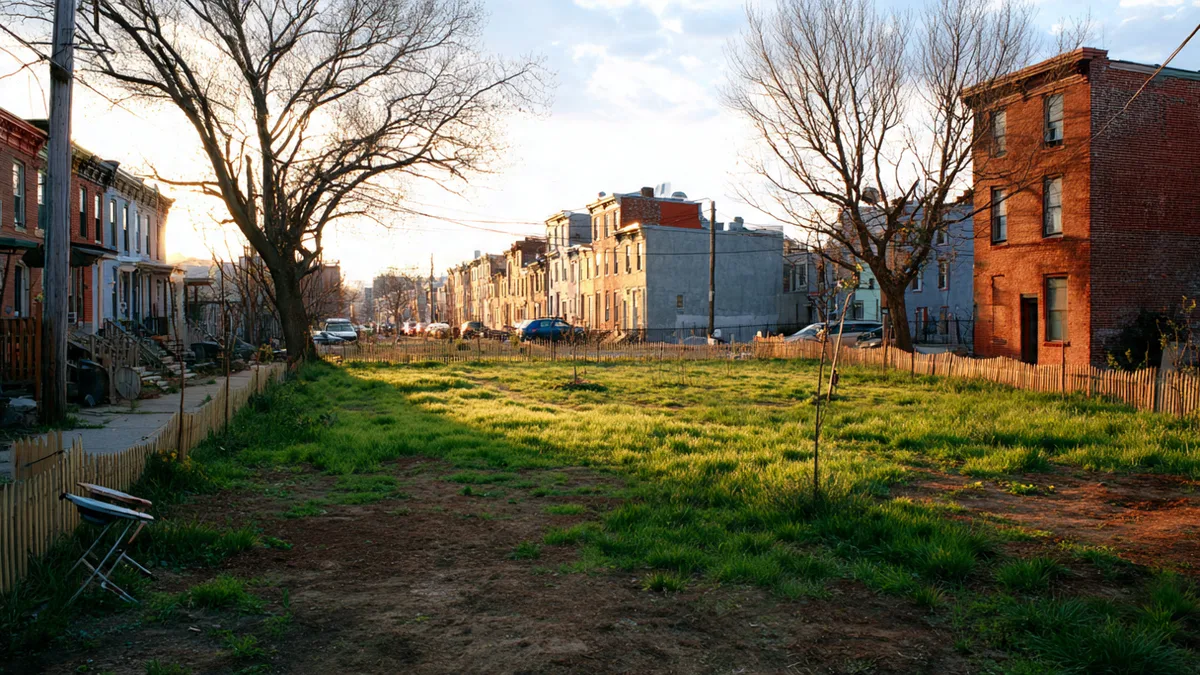
Branas and six colleagues designed what they believe was the first citywide cluster randomized controlled trial of vacant lot remediation ever conducted in the United States, selecting 541 vacant lots across Philadelphia at random, grouping them into 110 geographic clusters, and assigning each cluster to one of three conditions: full greening that included clearing trash, leveling the ground, planting grass and a handful of trees, and installing a low wooden post-and-rail fence; a lighter intervention of trash cleanup and mowing only; or no intervention at all, with local contractors doing the work and the Pennsylvania Horticultural Society managing ongoing maintenance.
The trial ran for 38 months while police records and surveys of 445 randomly selected residents tracked what happened.
Results split along income lines. In neighborhoods below the poverty line, greened lots were associated with a 29.1% reduction in gun violence (P < 0.001), a 21.9% drop in burglary (P < 0.001), and a 13.3% decrease in overall crime (P < 0.01). Residents near treated lots perceived 36.8% less crime and 39.3% less vandalism, reported a 57.8% decrease in fear of going outside, and used outdoor spaces for relaxing and socializing 75.7% more than control participants. The paper appeared in the Proceedings of the National Academy of Sciences in March 2018.
The Number Nobody Calculated
Greening costs approximately $1,600 per lot, with maintenance running $180 per year, and Philadelphia has more than 40,000 vacant lots.
Do the multiplication and the citywide price tag comes to roughly $64 million in the first year and $7.2 million annually to sustain, which works out to about $4.50 per Philadelphia resident per year for ongoing maintenance and a one-time initial outlay of roughly $40 per person. That is less than a single cup of coffee, annually, to sustain a program the trial showed reduced gun violence by 29% in the neighborhoods where shootings are most concentrated.
The city recorded 351 homicides in 2018, and the lifetime economic cost of a single gun homicide exceeds $1 million when combining medical care, criminal justice proceedings, and lost productivity. Prevent ten deaths per year and the program pays for itself before you count the secondary gains in mental health, property values, and community cohesion that the trial also measured.
Why Grass Stops Bullets
The mechanism is straightforward. Overgrown vacant lots provide concealment for drug deals, storage for illegal firearms that carry steep carry penalties, and escape routes during police pursuits. Philadelphia officers described certain lots as "gun closets" — stash spots hidden by weeds and brush. Clear the vegetation, install a token fence, and the concealment value drops to zero.
Physical opportunity, though, was only half the story. The trial's ethnographic component documented a second pathway that no policing model predicted: treated lots became spontaneous community gathering spaces where neighbors dragged out folding chairs, hosted cookouts, and let children play in the grass, creating a web of organic social surveillance that deterred criminal activity without a single officer or camera. Jane Jacobs called this process "eyes on the street" in 1961. Branas's trial, sixty years later, supplied the first experimental evidence that she was right.
Then came a third channel: a companion paper published in JAMA Network Open examined mental health outcomes from the same trial and found that residents near greened lots reported a 41.5% decrease in feeling depressed and a 62.8% reduction in overall poor mental health (DOI: 10.1001/jamanetworkopen.2018.0298). Violence and despair feed each other. Break the cycle at the environmental level and you interrupt a feedback loop that clinical interventions, delivered one patient at a time, cannot reach at population scale.
The Strongest Case Against
Displacement is the most credible objection: clean up one lot and criminals simply relocate to the next block, redistributing violence rather than reducing it. Branas and colleagues tested for this directly by analyzing police-reported crime in buffer zones radiating outward from treated lots and found no evidence of spatial migration. A 2019 reanalysis by Moyer, MacDonald, Ridgeway, and Branas in the American Journal of Public Health, which used the same trial data but isolated shooting incidents that resulted in injury or death, confirmed the result: significant reductions with no displacement (greening: −6.8%, 95% CI: −10.6% to −2.7%; mowing and cleanup: −9.2%, 95% CI: −13.2% to −4.8%).
Generalizability is the second concern, because one city proves a concept, not a law. But the effect has traveled. Heinze and colleagues replicated it in Flint, Michigan, where community-maintained vacant lots showed roughly 40% fewer assaults and violent crimes over four years. Gong and colleagues found consistent results in Youngstown, Ohio, across 2,100 street segments. Three cities. Different climates, demographics, policing cultures. Same direction.
What We Didn't Prove
The trial lasted 38 months. Nobody knows whether greening sustains crime reduction over a full decade, and continuous maintenance funding is the intervention's single structural vulnerability: if the budget lapses, lots revert to blight, and the informal social infrastructure that grew from the grass collapses with it, leaving the question of whether cities will fund indefinite upkeep entirely unanswered.
Effects concentrated in below-poverty neighborhoods, where crime rates were highest to begin with. In higher-income areas, results were weaker, inconsistent, and sometimes null. The 29% figure belongs to a specific context and cannot be applied naively to an entire metropolitan area, though that specificity is useful for targeting limited resources where they matter most.
The trial measured police-reported crime only, which means that domestic violence behind closed doors and unreported assaults never entered the data. The true impact on violence could be larger or smaller than the official statistics suggest.
The Bottom Line
For about $4.50 per resident per year, a city can maintain greened vacant lots and reduce gun violence in its poorest neighborhoods by roughly 29%, according to a cluster randomized controlled trial that covered a major American city for over three years, was replicated independently in two additional cities, showed no evidence of crime displacement, and produced secondary benefits for mental health and community cohesion.
A lawnmower is not a standard-issue public safety tool. The data say it should be.
What You Can Do
If you live near a vacant lot, contact your city's land bank or housing authority about adopting the space. Many cities provide free materials and maintenance support for resident-led cleanups. Philadelphia's LandCare program, which managed the lots in this trial, is one template worth copying.
If you work in local government, the evidence supports shifting a small fraction of public safety budgets toward vacant land remediation, because at $1,600 per lot, a single forfeited police SUV covers roughly 25 lots and the return in prevented violence dwarfs the cost.
If you vote, ask candidates whether they fund vacant lot greening, because three cities' worth of experimental data confirm the intervention works, and the open question is no longer effectiveness but adoption.