The Calorie Accountant's Mistake
Count your calories and eat less than you burn. The math is simple: a calorie of broccoli and a calorie of packaged cheese do the same work inside your body, because energy is energy and thermodynamics does not care about ingredient labels. This premise underpins every calorie-counting app, every portion-control guide, and most metabolic research of the last century. It is clean and elegant. The first randomized controlled trial to directly test ultra-processed food's effect on eating behavior found it incomplete.
What the NIH Metabolic Ward Found
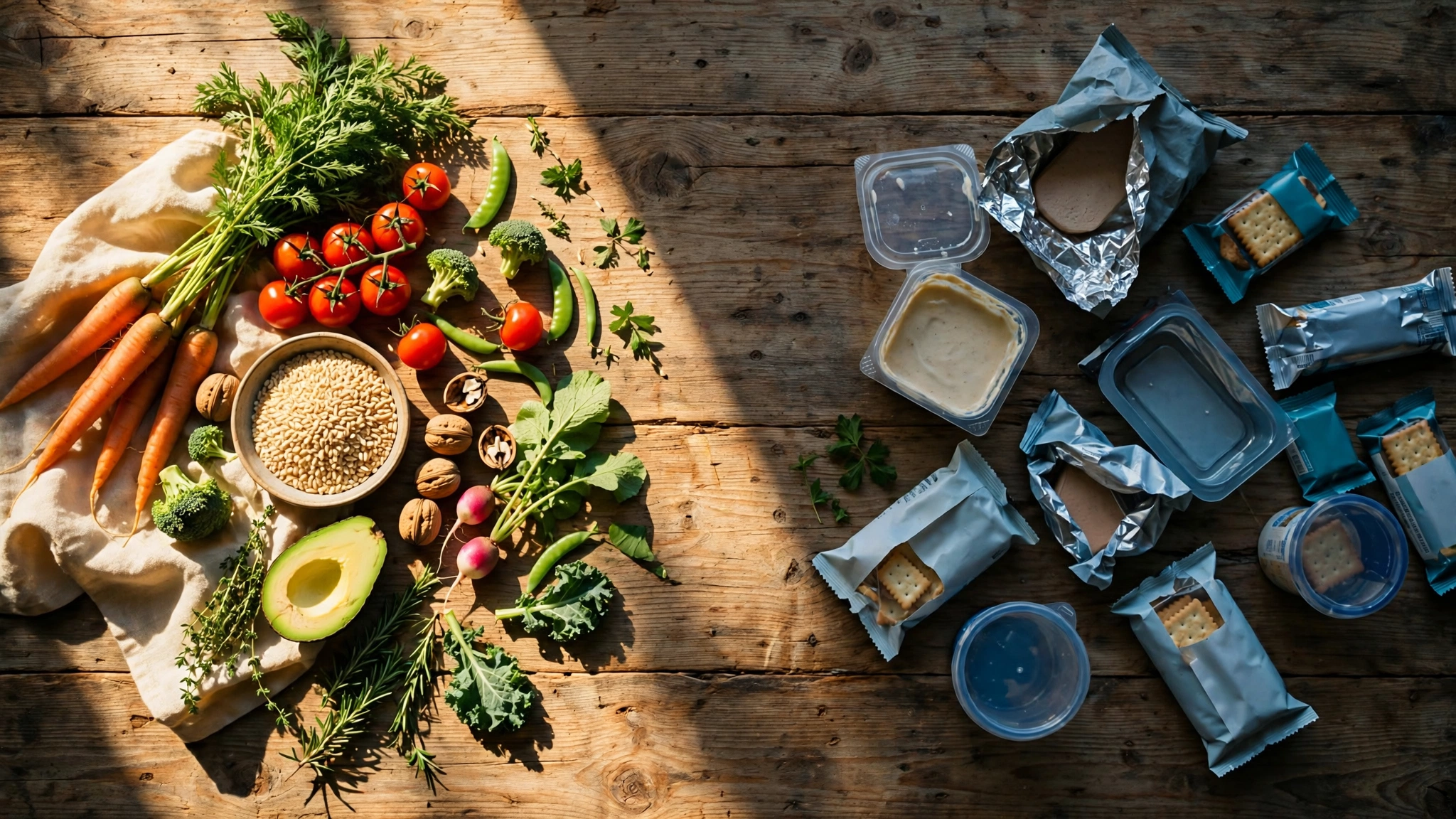
In 2019, Kevin Hall and colleagues at the National Institute of Diabetes and Digestive and Kidney Diseases did something no researcher had done before. They admitted 20 adults to an NIH metabolic ward for 28 consecutive days and fed them two carefully designed diets, each for two weeks, in random order. One diet was composed entirely of ultra-processed foods classified by the NOVA system: frozen meals, packaged snacks, refined breads, sweetened beverages, processed meats. The other was all whole foods: fresh vegetables, whole grains, lean meats, nuts, fruit.
The two diets were matched for presented calories, energy density, macronutrients, sugar, sodium, and fiber, which means that if the "calorie is a calorie" model were correct, participants should have eaten the same amount on both diets and maintained their weight. Meals were served in large portions with one instruction: eat as much or as little as you want.
On the ultra-processed diet, participants ate 508 more calories per day, an excess that broke down to 280 kcal/day from carbohydrate and 230 kcal/day from fat. Nobody tried to overeat. Protein intake was identical between diets, ruling out the popular "protein leverage" theory. In two weeks, participants gained 0.9 kg on ultra-processed food and lost 0.9 kg when they switched to whole food, even though both diets were rated equally pleasant and satisfying.
The correlation between energy intake and weight change was r = 0.8, unusually tight for nutrition research, and the p-value for the caloric difference was 0.0001.
Five Hundred Invisible Calories
A 508-calorie daily surplus is roughly a quarter of a standard adult's maintenance intake, enough to produce about a pound of weight gain per week if sustained, and participants achieved it without trying and without noticing any difference in taste or satisfaction.
According to a 2016 analysis in BMJ Open using NHANES data from 9,317 American adults, ultra-processed foods account for about 58% of total caloric intake in the United States; for children and adolescents, the figure approaches 67%. If the processing effect identified by Hall scales proportionally, then at the American average of 58% UPF, the food environment may be driving roughly 290 excess calories per day relative to an equivalent whole-food diet. Over a year, that implies approximately 30 pounds of potential weight gain before metabolic compensation starts to dampen the curve. Real-world weight gain is slower because bodies adapt, but the direction and magnitude help explain why obesity rates tripled between 1960 and 2020 despite widespread calorie awareness.
The Chewing Hypothesis
Participants ate faster on ultra-processed food. Much faster. Fazzino and colleagues confirmed this in a 2023 reanalysis published in Nature Food, finding that energy density, eating rate, and what they termed "hyper-palatability" all independently predicted higher energy intake.
In 2024, Hamano and colleagues at the University of Tokyo partially replicated Hall's result in a crossover trial of 9 Japanese men. The effect was even larger. The effect was even larger. Participants on the ultra-processed diet consumed 813 more calories per day and gained 1.1 kg in a single week. The study added wearable jaw sensors and found that chews per calorie dropped significantly on ultra-processed food, suggesting that soft, pre-processed food bypasses the mechanical satiety signals that accumulate during slower mastication: you finish eating before your body has time to tell you to stop.
The Strongest Case Against
Walter Willett, the most-cited nutritionist in the world, called two-week metabolic ward studies "less than useless because they are likely to be seriously misleading." His argument: short-term overconsumption effects wash out as the body adapts, because metabolic rate increases, appetite hormones recalibrate, and behavior shifts. David Ludwig, an endocrinologist at Boston Children's Hospital, added that the absence of a washout period between diet phases risks carryover effects and that the study's focus on food processing distracts from refined carbohydrate, which he considers the real culprit.
These are legitimate critiques, but they cut both ways: if metabolic adaptation dampens the overconsumption effect over time, the body is working against a persistent dietary drive, and that drive may explain why weight loss on calorie-restricted diets is so hard to maintain when the food environment remains ultra-processed. Hall himself addressed the carryover concern in a secondary analysis that found no evidence of carryover effects on energy intake, weight, or body composition.
What We Didn't Prove
The trial enrolled 20 healthy, weight-stable adults with a mean BMI of 27 and cannot speak to how ultra-processed food affects people with metabolic disease, eating disorders, or severe obesity. The NOVA classification system that defines "ultra-processed" is itself debated: a strawberry yogurt with added emulsifiers counts the same as a frosted doughnut, which critics argue conflates benign processing with harmful formulation. The study proved that something about ultra-processing drives overeating. It did not prove what. Until the mechanism is identified, reformulation efforts are shooting blind. Hall's second, larger trial, which he was running when he resigned from NIH in April 2025 citing censorship, has reported preliminary data suggesting that controlling hyper-palatability and energy density may neutralize the ultra-processed overeating effect, but those results are not yet peer-reviewed.
The Bottom Line
When two diets are matched for every nutrient that nutrition science has traditionally measured, the ultra-processed version still makes people eat 500 extra calories a day. The calorie-counting framework is not wrong; calories still determine weight. But the framework is incomplete. Something about the physical structure, texture, or formulation of ultra-processed food overrides the body's satiety signals in a way that calorie labels cannot capture. Counting calories from ultra-processed food is like measuring the octane of contaminated fuel: technically accurate, practically misleading.
What You Can Do
Replace one ultra-processed meal per day with a minimally processed alternative, because the Hall study found the caloric difference emerged immediately, meaning the benefit of swapping processed food for whole food begins on day one rather than after weeks of adaptation.
Read the ingredient list, not the nutrition label, because the NOVA system classifies food by process rather than nutrient profile: if the ingredient list includes substances you would not find in a home kitchen (maltodextrin, high-fructose corn syrup, soy protein isolate, hydrogenated oils, emulsifiers, flavor enhancers), the product is ultra-processed regardless of what the front-of-package claims say.
Eat more slowly, and choose foods that make you chew. The data consistently show people eat faster on ultra-processed food, and eating rate independently predicts caloric intake, so foods that require more chewing — raw vegetables, whole grains, nuts, fibrous fruit — naturally slow consumption and give satiety hormones time to register. A practical test: if you can finish the meal in under fifteen minutes without effort, the food is probably doing too much of the work for you.