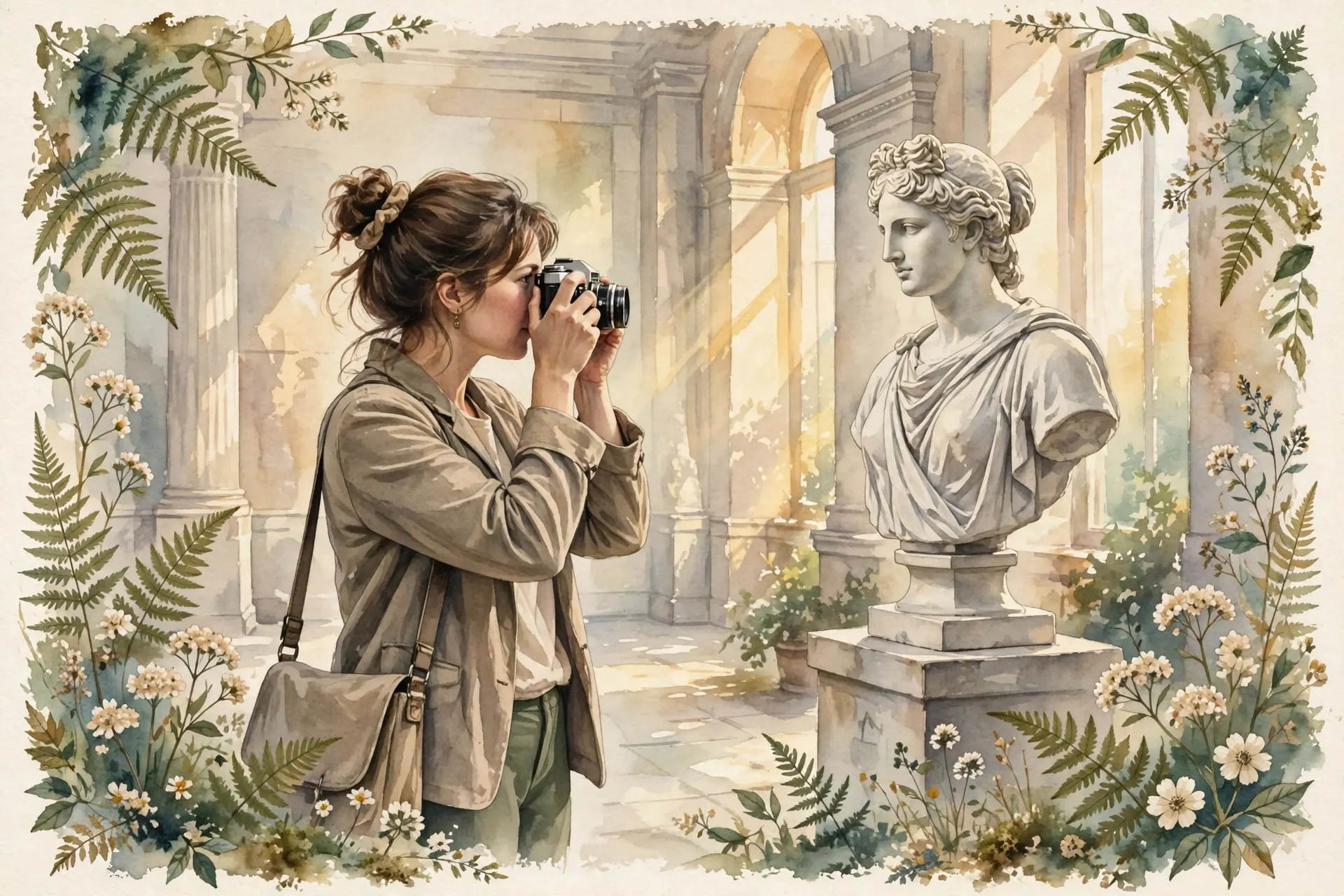
The Camera as a Second Brain
You take the photo so you will remember, and that is the whole point of raising the phone, framing the shot, and tapping the shutter, because the moment is precious, the memory is fragile, and the camera promises to hold it for you, yet the idea feels like common sense and is also, according to a decade of experiments, partly backwards.
Linda Henkel, a psychologist at Fairfield University, got the idea watching museum visitors. People stood in front of a painting for a few seconds, snapped a picture, and moved on. She wondered whether photographing was helping them remember the art or quietly replacing the job of remembering it. She published the answer in 2014, when people were already taking more than 3 billion photos a year, and it was not flattering to the camera.
Thirty Objects, Two Kinds of Looking
Henkel led 27 undergraduates on a guided tour of Fairfield’s Bellarmine Museum of Art, where they stopped at 30 objects, paintings, sculptures, pottery, tools, jewels, and mosaics, and spent 30 seconds at each one, simply looking at 15 while for the other 15 they looked for 20 seconds, then spent 10 seconds lining up a shot and taking a photograph, before coming back the next day to be tested on what they remembered.
The photographed objects lost. Asked multiple-choice questions about visual details, what the Tang Dynasty warrior held in his hands, students scored significantly worse on the objects they had photographed than on the ones they had only observed, F(1, 26) = 10.95, p = .003, with an eta-squared of .42, and they were also slightly worse at recognizing which objects had been on the tour at all, 88 percent correct for photographed objects against 91 percent for observed ones.
Here is what that gap means in plain numbers: converting the detail-memory test statistic to a standardized effect gives a Cohen’s dz of about 0.64, since t equals the square root of 10.95, which is 3.31, and dividing by the square root of 27 participants gives 0.64, a medium-to-large effect for a within-person comparison.
The Zoom Trick
Henkel ran the study again with 46 students and a twist: this time the tour had 27 objects, and each student photographed nine whole, zoomed in on nine, and only observed nine, with the photographed objects getting extra time, 25 seconds of looking first and then the photo on top, so a looking-time artifact should have vanished, and it did not.
Detail memory was again worse for objects photographed as a whole than for objects only observed, F(2, 90) = 5.15, p = .008, but the zoomed-in photos broke the pattern completely, since students remembered details of zoomed objects just as well as observed ones, and not only for the zoomed part: detail accuracy was 48 percent for the zoomed feature and 45 percent for features left out of frame, statistically identical. Choosing a detail forced them to really look, and that looking protected the whole object.
Location memory told a different story, and it was the biggest effect in the paper, since asked which of the museum’s four rooms each object had stood in, students were far worse for anything they had photographed, F(2, 90) = 32.68, p < .001, eta-squared .73. Zooming in made it worse still, since the attention that saved detail memory was spent on the object, not the room.
Why It Happens
Henkel’s first suspect was cognitive offloading, the habit of letting a device hold information so the brain does not have to, the same logic that explains why people remember less of a fact they expect to search for later, but a 2018 follow-up by Julia Soares and Benjamin Storm at UC Santa Cruz suggests offloading is not the whole story. They had students photograph paintings on screen, then delete the photo immediately, through Snapchat or by hand, so no external record survived. Memory was impaired anyway, by as much as 20 percent on multiple-choice tests, so the damage happened during the taking, not during the keeping.
Their preferred explanation is attentional disengagement: framing a shot, checking focus, and confirming the capture all pull attention toward the camera’s job and away from the object, and the effort creates a false sense of completion, a feeling that the encoding is done because the shutter clicked, so the brain files the moment as handled and moves on.
The Strongest Counterargument
The case against Henkel’s version is real, and it comes from a team that found the opposite result when people chose their own shots, since in 2017 Alixandra Barasch and colleagues ran one field study and three lab experiments in which participants photographed whatever they wanted, and the photo-takers recognized more of what they saw than people without cameras while remembering less of the audio guide. A pooled analysis confirmed both halves.
The difference is choice: Henkel told students what to photograph, while Barasch let them decide, so choosing a shot directs attention toward visual detail, which is exactly what a museum rewards, and away from sound, which is exactly what an audio guide delivers. A later lab series by Lurie and Westerman in 2021 found the same impairment on perceptual and conceptual tests when photos were directed. The honest summary is narrower than the headline version: photographing on command costs you detail and context, while photographing by choice trades what you hear for what you see.
What We Didn’t Prove
The samples were small and young: 27 and 46 undergraduates at one university, tested the next day, on art objects they had no personal connection to. Nobody tested whether the effect holds for your own child’s birthday, a view you love, or a photo you actually revisit, and Henkel herself noted that reviewing photos later can restore memories, since the camera’s record only helps if you open it. The studies used digital cameras in 2013, not phones, and measured memory a day later, not a year later. What the evidence does establish is narrower and still useful: in the minutes after you take a directed photo, your memory for that thing is measurably thinner.
The Bottom Line
The camera does not steal your memories. It rents them out, and the rent is attention. Photograph a whole object on autopilot and you will remember fewer of its details and less of where it stood, but zoom in on one detail or choose the shot yourself and the cost mostly disappears, because choosing forces you to look. The photo is only as good a memory as the attention you paid while taking it.
What You Can Do
At a museum or on a trip, look first and photograph second, giving each thing ten unhurried seconds before the phone comes out, since the impairment comes from the camera interrupting the looking, not from the photo itself. When you do shoot, zoom in on one detail instead of capturing the whole scene, since the detail forces attention and protects memory for the rest of the object. At concerts, put the phone away for the parts you want to hear, since free-choice photography trades auditory memory for visual memory. Once a week, open the camera roll and look at five photos, because reviewing turns a stored image back into a memory.
Sources
- Henkel, L. A. (2014). Point-and-shoot memories: The influence of taking photos on memory for a museum tour. Psychological Science, 25(2), 396-402. doi:10.1177/0956797613504438
- Soares, J. S., & Storm, B. C. (2018). Forget in a flash: A further investigation of the photo-taking-impairment effect. Journal of Applied Research in Memory and Cognition, 7(1), 154-160. doi:10.1016/j.jarmac.2017.10.004
- Barasch, A., Diehl, K., Silverman, J., & Zauberman, G. (2017). Photographic memory: The effects of volitional photo taking on memory for visual and auditory aspects of an experience. Psychological Science, 28(8), 1056-1066. doi:10.1177/0956797617694868
- Lurie, R., & Westerman, D. L. (2021). Photo-taking impairs memory on perceptual and conceptual memory tests. Journal of Applied Research in Memory and Cognition, 10(2), 258-268. doi:10.1016/j.jarmac.2020.11.002
- Sparrow, B., Liu, J., & Wegner, D. M. (2011). Google effects on memory: Cognitive consequences of having information at our fingertips. Science, 333(6043), 776-778. doi:10.1126/science.1207745
- Association for Psychological Science. (2013). No pictures, please: Taking photos may impede memory of museum tour. APS press release