The Imperceptible Upgrade
The practice spread from Silicon Valley to Wall Street to suburban wellness communities in about five years. Take one-tenth of a recreational dose of LSD or psilocybin mushrooms, two or three times a week. Don't get high. Don't hallucinate. Just feel sharper. More creative. Less anxious. Surveys of microdosers consistently reported improvements across the board: better mood, enhanced focus, greater life satisfaction.
By the early 2020s, the psychedelic wellness industry had become a multibillion-dollar phenomenon. Supplement companies sold legal psilocybin truffles in the Netherlands. Underground guides offered microdosing protocols by subscription. James Fadiman's 2011 book The Psychedelic Explorer's Guide had become a self-help manual for a generation convinced it had found the ultimate cognitive upgrade, and observational studies from the psychedelic research community were reinforcing every optimistic claim.
There was just one problem. Nobody had run a placebo-controlled test.
Blinding Yourself
The obstacle was regulatory. Psychedelics are Schedule I in most countries, making controlled trials prohibitively expensive. So Balázs Szigeti, a research associate at Imperial College London's Centre for Psychedelic Research, designed something unusual: a citizen-science trial where participants blinded themselves.
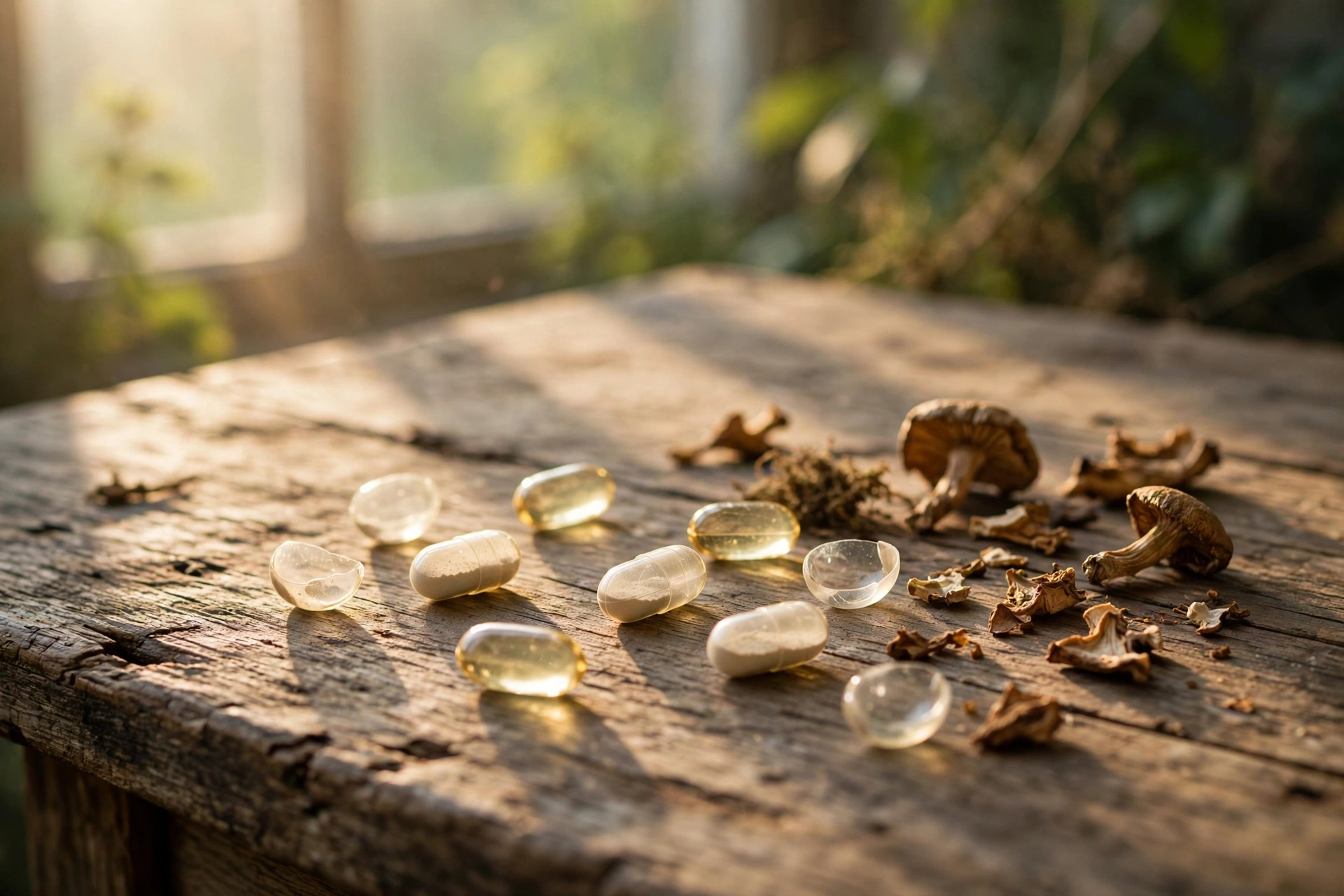
He recruited people who were already microdosing. More than 1,600 signed up. Each received opaque capsules, zip bags, envelopes, and QR codes. They filled some capsules with their own psychedelic supply and left others empty as placebos. Then they followed a randomization protocol: capsules went into weekly sets, sets went into envelopes, envelopes were shuffled and sealed so the participants couldn't tell which weeks they'd be taking the drug and which weeks they'd be swallowing nothing. QR codes on each envelope let the research team track the true contents after the fact.
After dropouts, 191 participants completed the four-week trial, roughly evenly split between a full microdose regimen, a half-dose regimen, and a full placebo regimen. They filled out validated psychological surveys and took cognitive tests at baseline, weekly during dosing, and at the end.
Both Groups Got Better. Neither Got Better Than the Other.
The results looked, at first, like vindication. Participants who microdosed reported significant improvements from baseline in well-being, mindfulness, life satisfaction, and reduced paranoia. But the placebo group improved by the same amount. On every psychological measure the researchers assessed, the gap between drug and placebo was statistically zero.
Cognitive tests were even more deflating. The microdose group showed no improvement from baseline on any objective measure. Neither did the placebo group. Whatever was happening, it wasn't making anyone demonstrably smarter.
One result did emerge clearly. When researchers looked at who reported feeling better — regardless of what they actually took — the pattern was stark: people who believed they had taken a psychedelic felt greater well-being and lower anxiety than those who believed they took a placebo. The improvement tracked with belief, not biochemistry. Participants correctly guessed what they'd taken 72% of the time, well above chance, and those who guessed correctly reported the largest benefits.
Here's a calculation nobody in the microdosing community seems to have run. If 5.5 million Americans have tried microdosing (a conservative extrapolation from the 2019 Global Drug Survey, which found 2.6% of respondents had microdosed) and a typical protocol costs $50 to $200 per month, the practice represents somewhere between $275 million and $1.1 billion annually in the United States alone. All of it chasing effects that, in the only large placebo-controlled test, proved indistinguishable from expectation.
The Strongest Counterargument
The most serious challenge comes from a 2024 review in Frontiers in Psychiatry that systematically critiques the entire microdosing evidence base. The reviewers argue that Szigeti's non-significant result does not prove the drug is inert. In frequentist statistics, absence of evidence is not evidence of absence. The study's participants were overwhelmingly healthy volunteers with subclinical symptoms, and the instruments used (like the QIDS depression scale, which shifts by about 1 point on a 27-point range in this population) may have lacked the sensitivity to detect small but real improvements. Drug quality was unknown and uncontrolled. The 72% correct-guess rate means the blinding was imperfect, potentially contaminating both groups with expectation effects. The reviewers suggest that a clinical population with diagnosed depression or anxiety, where there's more room for measurable improvement, might respond differently. This objection remains unresolved. At least two randomized, double-blind clinical trials of microdosing in major depression are underway, but neither has published results.
What We Didn't Prove
This trial used a self-blinding protocol, not the gold-standard double-blind design where an independent team controls drug administration. Participants sourced their own drugs, introducing unknown variation in substance, purity, and dose. The 72% correct-guess rate means many participants likely knew what they were taking, weakening the placebo comparison from both directions. All 191 completers were existing microdosers with optimistic expectations, a self-selected group predisposed to report positive effects regardless of condition. The trial did not include people with diagnosed psychiatric conditions, so it cannot address whether microdosing would work as a clinical treatment. A separate 2022 double-blind psilocybin trial by Cavanna et al. in Translational Psychiatry with 34 participants reached a compatible conclusion, but that sample is too small for firm generalization. No large-scale, pharmaceutical-grade, double-blind trial of repeated microdosing has been completed.
The Bottom Line
The story of microdosing follows a familiar arc: a plausible idea, a flood of enthusiastic testimonials, and then a controlled test that finds the enthusiasm was doing all the work. 191 people microdosed psychedelics or swallowed placebo capsules for four weeks, and both groups reported the same psychological improvements. Cognitive performance didn't budge in either group. The participants who felt the most benefit were the ones who believed they'd taken the drug, whether they had or not. Microdosing may yet prove pharmacologically active when properly tested in clinical populations, but the largest controlled trial to date found that the revolution in sub-perceptual psychedelic enhancement is, so far, indistinguishable from hope.
What You Can Do
If you're currently microdosing and feeling genuine benefits, this research doesn't demand you stop. The improvements are real for you. They just may not require the drug. Consider running your own informal blind test: have a trusted friend prepare identical capsules with and without your substance for two weeks, then evaluate honestly whether you can tell the difference. Before investing more money or legal risk, wait for results from the ongoing double-blind clinical trials at the University of Toronto (psilocybin for major depression, NCT05259943) and European centers (LSD for depression, ACTRN12624000128594), which will test whether microdosing works in people who actually need treatment. If you're dealing with depression, anxiety, or cognitive concerns, options with stronger controlled evidence exist today: full-dose psilocybin-assisted therapy (in clinical trials or legal in Oregon and Colorado), SSRIs, cognitive behavioral therapy, and regular exercise all outperform microdosing on the current evidence.