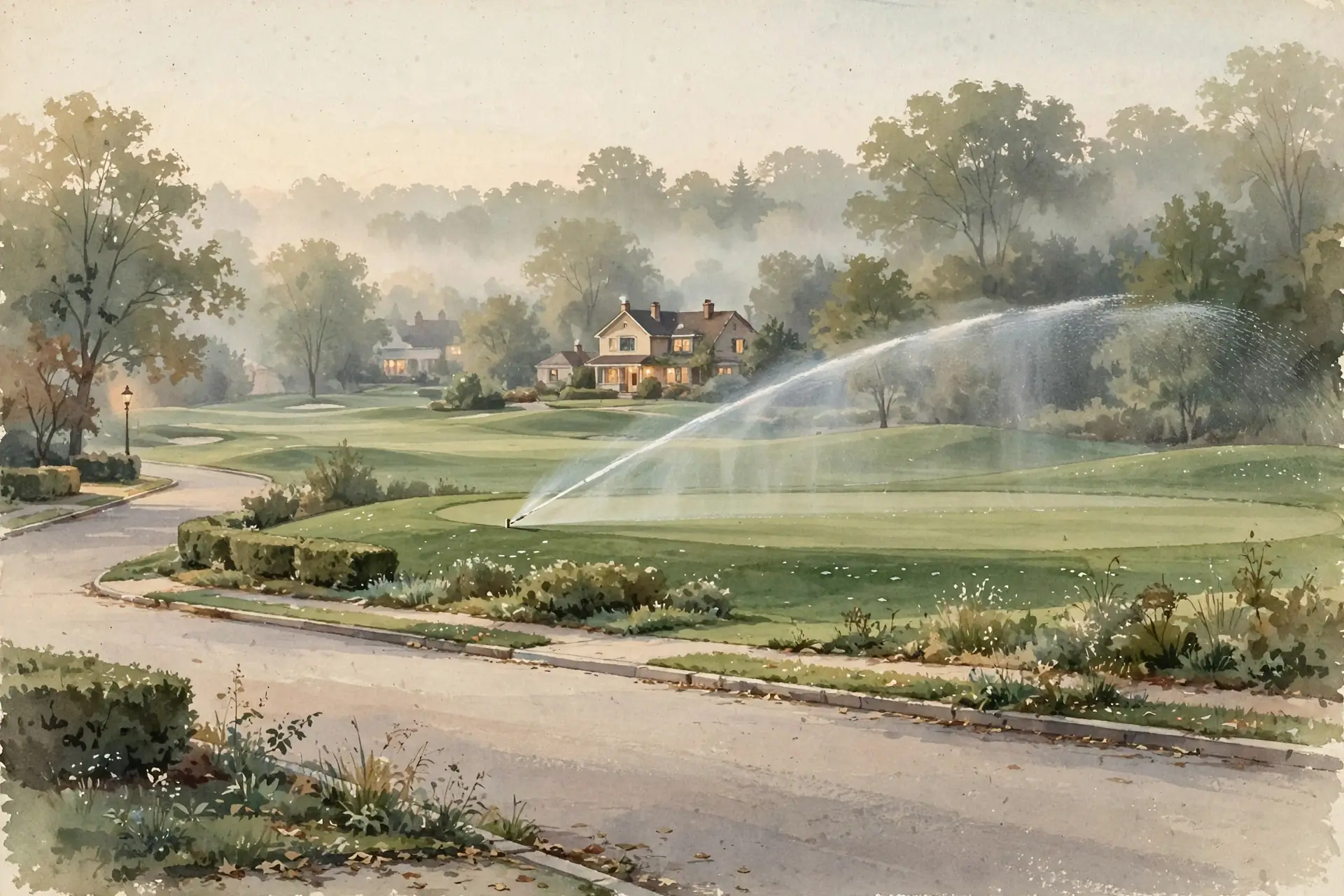
The Greenest Neighborhoods May Be the Least Healthy
Decades of public-health research have delivered a comforting message: live near green space and you will live longer. Parks, trees, and lawns are linked to lower stress, more activity and cleaner air, and markets price that belief in: homes beside golf courses command premiums from buyers who assume the manicured fairways outside their windows are an amenity rather than an exposure.
A new study questions that assumption, because a golf course is among the most chemically managed patches of land in America: to keep every blade uniform, superintendents spray herbicides, insecticides, and fungicides on a schedule no public park could afford, at up to fifteen times European rates, the authors say. Green is not one thing.
419 Cases, 139 Courses
Brittany Krzyzanowski, a geographer at the Barrow Neurological Institute, teamed with Mayo Clinic neurologists, including E. Ray Dorsey, to test whether that chemical load reaches the neighbors, using the Rochester Epidemiology Project, a medical-records linkage system covering southern Minnesota and western Wisconsin, to identify every incident Parkinson’s case diagnosed in Olmsted County from 1991 to 2015.
A movement-disorder specialist confirmed each diagnosis and dated motor-symptom onset, yielding 419 cases with a median age of 73 alongside 5,113 matched controls, first matched on age and sex at roughly twenty to one and then filtered for complete residency data; the team digitized 139 golf courses from satellite imagery and measured each person’s home address, the address two to three years before symptom onset, to the nearest course edge, then layered on the water data: 224 municipal water service areas, 711 municipal wells, and the state agriculture department’s groundwater-vulnerability map. Every model adjusted for age, sex, race and ethnicity, year, neighborhood income, urban or rural status, and health-care use.
Risk Fell With Every Mile
The gradient was the story: cases lived a median of 1.72 miles from the nearest course against 1.98 miles for controls, a small gap that cleared statistical significance.
Within one mile versus beyond six miles, the odds of Parkinson’s ran 126 percent higher, an adjusted odds ratio of 2.26 with a 95 percent confidence interval of 1.09 to 4.70; one to two miles showed 198 percent higher odds, two to three miles 121 percent higher, and each additional mile of distance out to eighteen miles was associated with 9 percent lower odds.
The water data agreed, with water service areas containing a golf course carrying nearly double the odds of areas without one, an adjusted odds ratio of 1.96, and 49 percent higher odds than private wells, while geologically vulnerable groundwater added another 82 percent. The authors’ reading: pesticides drifting through air and leaching into wells, with paraquat and rotenone as the usual suspects.
The Arithmetic Nobody Did
Press coverage reported relative risks, but absolute terms change the feel: Parkinson’s affects about one percent of people over sixty, per the Parkinson’s Foundation, and for an uncommon disease an odds ratio approximates a relative risk, so 2.26 becomes an absolute risk near two to two-and-a-half percent within a mile of a course versus about one percent beyond six miles, or roughly one to one-and-a-half extra cases per hundred older adults.
Inputs: the paper’s own odds ratio and the Foundation’s prevalence figure. Assumption: the Minnesota estimate travels. A second calculation checks internal consistency: the per-mile model cuts odds nine percent per mile, so five miles outward should multiply odds by 0.91 to the fifth power, which is 0.62, a 38 percent reduction, against the categorical contrast’s steeper implied drop to 44 percent of the within-one-mile odds.
The mild disagreement is informative, because the authors’ spline shows risk flat within three miles and then declining, meaning the linear per-mile average smooths over two distinct regimes. That is the shape of spray drift: falling with distance, never quite zero at the fence.
The Strongest Counterargument
The fiercest criticism came from Parkinson’s UK, and it deserves full strength before any verdict: David Dexter, the charity’s research director, noted that Parkinson’s pathology starts in the brain ten to fifteen years before diagnosis, while the study anchored exposure to an address two to three years before symptoms, so if the disease was already underway a decade earlier, the measured exposure may postdate the biology.
Dexter also flagged the urban imbalance, roughly eighty percent of cases in urban areas versus about thirty percent of controls, which turns traffic exhaust, industrial pollutants, and every urban-clustered exposure into competing suspects; and nobody tested a drop of water or a breath of air for pesticides, so the vulnerability map is geology rather than chemistry and a water service area with a golf course is a plausible route rather than a measured dose.
Katherine Fletcher, the charity’s research lead, added that occupational exposure and genetics went unmeasured, called the pesticide framing reductive, and noted that paraquat is banned in Britain and the EU, which limits how far a Minnesota finding travels.
In fairness, the authors adjusted for urban/rural status and ran urban-only sensitivity analyses, so the gap was statistically addressed, though adjustment cannot conjure unmeasured data; the population was also 88.1 percent White and entirely Midwestern.
What We Didn’t Prove
Case-control studies cannot prove causation; they show the dice came up oddly, and Dexter’s temporal mismatch is real: addresses predate symptoms, but symptoms postdate the disease by years, so the exposure window may be wrong.
No pesticide was measured anywhere in this study, so the causal story rests on proxies stacked on proxies: distance for drift, service areas for shared supply, geology for contamination.
Thirty-nine percent of matched controls were dropped for incomplete residency data, and survivors of a filter that aggressive may not represent their region; the finding is unreplicated, one study, one dataset, one 2025 paper. Treat the mechanism as a hypothesis with strong circumstantial support, not an established fact.
The Bottom Line
A careful, well-adjusted case-control study found Parkinson’s odds more than doubled within a mile of a golf course, with drinking-water patterns implicating pesticides as the delivery route. The effect sizes are large, the gradient is clean, the water data corroborate the distance data. But no pesticide was ever measured, the exposure window may miss the disease’s true onset by a decade, and no independent team has replicated the finding. A serious hypothesis for regulators to test, not a verdict on your address.
What You Can Do
First, learn your water source. Municipal or private well is usually one search away, and your utility’s annual Consumer Confidence Report will say what gets screened and what was found.
Second, if you are on a private well near a course, consider testing for common turf pesticides through a state-listed lab. An activated-carbon filter certified to NSF/ANSI 53 cuts many pesticide residues.
Third, ask your course for its spray schedule. Many post application days; keeping windows closed during and after spraying costs nothing.
Fourth, push for testing, not panic. The authors called for public-health policies on pesticide contamination and airborne exposure around courses. A letter to your water board citing a JAMA Network Open paper outweighs a worried group chat.
Fifth, do not list your house over one unreplicated study. A flag for regulators first, a personal risk factor a distant second.