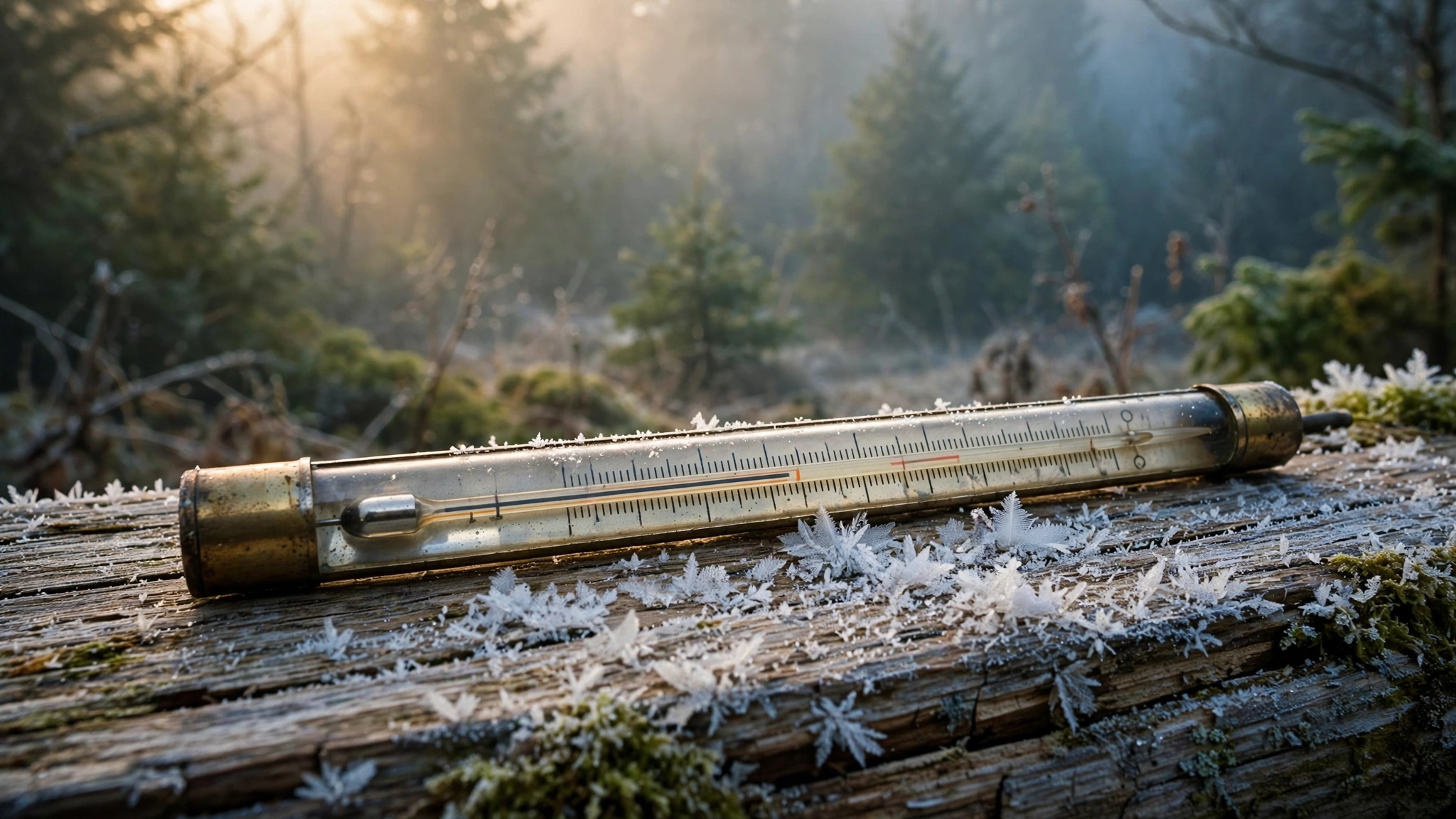
The Most Famous Number in Medicine Is Wrong
In 1851, a German physician named Carl Reinhold August Wunderlich measured the armpit temperature of 25,000 patients in Leipzig and declared the human norm: 37°C, or 98.6°F. The number entered textbooks, then thermometer packaging, then the parental lexicon of worry. It has been recited so many times, in so many exam rooms and medicine cabinets, that questioning it feels like questioning whether water is wet.
But Julie Parsonnet, an infectious disease specialist at Stanford, had been seeing something odd in her clinic. Patients kept registering below 98.6°F even when they were perfectly healthy. Not by a trivial margin. In 2020, her team published what would become one of the most quietly radical findings in modern physiology: that 98.6°F was never wrong for Wunderlich's era, but it no longer describes us. We have been cooling off, steadily and measurably, for more than a century and a half.
Three Cohorts, 677,423 Thermometers
Protsiv, Parsonnet, and colleagues assembled temperature data from three populations separated by enormous gaps in time. The first came from the Union Army Veterans of the Civil War, whose medical records between 1860 and 1940 contained 83,900 temperature readings from 23,710 men. The second was a slice of the National Health and Nutrition Examination Survey from the early 1970s, with 15,301 readings. The third pulled 578,222 readings from 150,280 patients treated at Stanford clinics between 2007 and 2017.
After adjusting for age, height, weight, ethnicity, and time of day, a pattern emerged that would have startled Wunderlich. Body temperature declined monotonically by 0.03°C for every birth decade. Men born in the early 1800s ran 0.59°C warmer than men born at the turn of the 21st century. Women showed a parallel decline of 0.32°C since the 1890s, the earliest decade for which their data were available. Converted to the Fahrenheit scale Americans know from their bathroom drawers, the drop in men amounts to 1.06°F. The modern average hovers around 97.5°F.
Not a Thermometer Problem
The obvious objection writes itself: maybe old thermometers ran hot. Parsonnet's team anticipated this and built their strongest defense into the study design. Within the Union Army cohort alone, where every temperature was presumably taken with the same instruments under the same protocols, men born in the 1820s consistently ran warmer than men born in the 1840s. The within-cohort decline mirrored the between-cohort decline. If old thermometers were simply miscalibrated, birth decade should not have mattered.
There is also a direction-of-bias argument. Wunderlich measured in the armpit; modern clinicians measure orally. Axillary readings tend to run about 1°C lower than oral. If anything, the comparison between Wunderlich's axillary data and today's oral data should underestimate the real decline, not overestimate it.
The Bolivian Confirmation
Six months after Protsiv's paper, a research group led by Michael Gurven at UC Santa Barbara published a remarkable replication in Science Advances. Gurven had been studying the Tsimane, an indigenous forager-horticulturalist population in the Bolivian Amazon, for 16 years. His team analyzed 17,958 temperature measurements from 5,481 Tsimane adults collected between 2002 and 2018.
The Tsimane still experience frequent infections. They have limited access to modern medicine. Their living conditions have changed far less than those in industrialized nations. And yet their body temperatures dropped by 0.9°F in less than two decades, a decline compressed into 16 years that took Americans roughly 150.
"No matter how we did the analysis, the decline was still there," Gurven's collaborator Thomas Kraft told interviewers. "Even when we restricted analysis to the less than 10% of adults who were diagnosed by physicians as completely healthy, we still observed the same decline in body temperature over time."
This result matters because it dismantles the simplest explanation. If the American cooling were driven only by reduced chronic infection from antibiotics and modern sanitation, a population with persistent infections should not show the same trend. Something else is happening.
Why Are We Cooling?
Parsonnet's team points to a decrease in basal metabolic rate. Body heat is a byproduct of metabolism: the chemical reactions that keep you alive produce warmth as exhaust. Resting metabolic rate accounts for roughly 65% of daily energy expenditure in a sedentary person. A cooler body, on average, implies a body that is burning fewer calories at rest.
The leading candidate explanation is a population-wide reduction in chronic inflammation. In the 19th century, tuberculosis, syphilis, malaria, and severe periodontal disease were endemic. Chronic inflammation raises baseline body temperature even in the absence of acute fever. As sanitation, antibiotics, dental care, and public health infrastructure improved, background inflammation declined, and body temperature followed.
But the Tsimane data complicates the story. Gurven suspects the answer involves not just fewer infections but a different physiological response to infections: better nutrition, wider access to anti-inflammatory medications like ibuprofen, and changes in physical activity patterns. The decline appears multicausal, and no single variable fully accounts for it.
What This Means for Detecting Fevers
Here is an original calculation that clinicians should find uncomfortable. The traditional fever threshold is 100.4°F, set as a meaningful elevation above the 98.6°F baseline. That threshold implies a deviation of 1.8°F. But if today's true baseline is 97.5°F, a patient would need to reach only 99.3°F to show the same proportional deviation that a 19th-century patient showed at 100.4°F. At the old threshold, a modern patient has already deviated by 2.9°F from their actual resting temperature, a swing that would have represented 101.5°F in Wunderlich's population.
In practical terms, clinicians using the 100.4°F cutoff may be missing fevers in the early stages of infection. A patient presenting at 99.5°F and being told they are "just below a fever" may in fact be running 2°F above their personal normal. Parsonnet herself has noted that at least 75% of healthy adults now register below 98.6°F, and in elderly patients, reaching 98.6°F at all would be unusual.
The Strongest Case Against
The most substantive criticism is that all three American cohorts measured different populations under different conditions, and the adjustments for confounders, however careful, cannot fully simulate a true longitudinal study. The Union Army data comes exclusively from white and Black men, many with war injuries. The NHANES sample is nationally representative but from a single four-year window. STRIDE patients visited Stanford clinics in Palo Alto, which skews affluent and educated. It is possible that unmeasured differences between cohorts, rather than a genuine biological shift, explain part of the gradient.
This is a legitimate concern. But the within-cohort analysis, in which the Union Army data alone shows the same birth-decade decline without any change in measurement technology, substantially weakens it. And the Tsimane replication, conducted longitudinally in a single population with consistent methodology over 16 years, provides the exact kind of evidence the cross-cohort design lacks.
What We Didn't Prove
- The exact cause of the decline remains undetermined. Reduced inflammation is the leading hypothesis, but the Tsimane data suggests the picture is more complex.
- Whether the decline has health consequences, good or bad, is unknown. Lower basal metabolic rate could extend lifespan or simply reflect changes in body composition.
- The study does not establish whether the decline has plateaued or continues. If 0.03°C per decade persists, the average will reach 97.0°F within a generation.
- Individual variation is large. Some healthy adults still run at 98.6°F. The decline is a population mean, not a prescription for any one person.
What You Can Do
- Establish your own baseline. Take your temperature at the same time of day for several days when you are healthy. Your personal normal is a far better reference than the 98.6°F printed on the box.
- Reframe your fever threshold. If your baseline runs at 97.4°F and you spike to 99.5°F, that is a two-degree jump and worth paying attention to, even if it falls below the official 100.4°F cutoff.
- Tell your doctor. Mention your personal baseline when reporting symptoms. A reading of 99.2°F in someone who normally runs at 97.5°F is clinically different from the same reading in someone who runs at 98.4°F.
- Be especially attentive with elderly patients. Older adults tend to run cooler. A temperature of 99.0°F in an 80-year-old may represent a more significant immune response than 100.4°F in a 25-year-old.
The Bottom Line
The most widely memorized number in medicine was accurate when it was measured. It has been drifting downward ever since, at a pace visible within single generations and confirmed across continents. The decline tells a story about how profoundly we have altered our own biology through changes to our environment, our diets, and our relationship with infectious disease. The thermometer has not changed. We have.